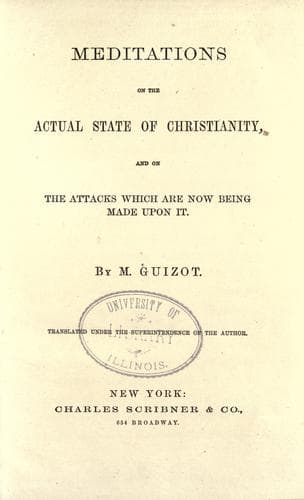
Meditations on the Actual State of Christianity, and on the Attacks Which Are Now Being Made Upon It.Guizot, François
Religion
Meditations on the Actual State of Christianity, and on the Attacks Which Are Now Being Made Upon It.
Guizot, François
Christianity; Philosophy and religion; Religious thought -- 19th century
In his discourse which he pronounced in 1813, on resuming his
functions at the "Faculté des Lettres," M. Royer-Collard summed
up his conclusions upon this fundamental question--conclusions
very different, more different essentially than even apparently
they are, from those arrived at by M. Jouffroy. Whereas M.
Jouffroy believes systematic skepticism forever invincible,
"because he regards it as the final word of the reason concerning
the reason," M. Royer-Collard, on the contrary, ends his
discourse with these words: "We cannot divide man; we cannot
assign a part only to skepticism; as soon as skepticism once
penetrates into the understanding, in [it?] invades it
throughout." I would confirm this conclusion of M. Royer-Collard,
by carrying still further the reasoning which led him to it.
{356}
"The most general result," says he, "presented by the history of
modern philosophy--its most striking characteristic when
contrasted with ancient philosophy--is its skepticism with
respect to the existence of the external world; that world in
which mankind has so long believed, which begins to reveal itself
in us with our existence itself, and in the bosom of which we are
forced to perceive ourselves as mere fragments of its immensity.
... I am not here to reason in favor of the received opinion;
that opinion needs neither proofs nor defenders; it is rooted
deeply enough in our most intimate nature to brave all attack. It
is not the world that risks anything at the hands of the
philosophers; it is rather the honor of philosophy which suffers
some discredit; it is rather philosophy that relieves the vulgar
from a part of the respect which philosophy yet demands at its
hands, when it gives birth to paradoxes bearing, seemingly, the
very impress of folly.
{357}
Moreover, whether the material world really exist or not, is not
a matter in controversy; this question would resolve itself into
one still more general--whether all those facilities of ours, of
which the authority is indivisible, are organs of truth or organs
of falsehood; and upon this point we shall ever be driven to
accept the testimony of those very organs. The sole question
which belongs to philosophical analysis, consists in examining if
it be certain that our faculties attest to us the existence of an
external world, and if the human race believes in this existence;
for if it believes in it, this universal belief becomes a fact in
our intellectual constitution; and whether this fact be a
primitive one, or a deduction from any anterior fact--whether it
be the immediate teaching of nature or an acquisition by
reasoning--it is entitled to its place unmutilated in the
synthetic table of science. Has it disappeared? Then the man of
philosophy is not the man of nature; science is false, and
consequently, the analysis without fidelity; and one may rest
assured that philosophers have inserted in the understanding some
principle, or some fact, which was not there before; or that they
Public-domain text, read in full here on John Shaqi.
Reviews
Reviews
No reviews yet
Be the first to share your thoughts on this work.
Elsewhere in the archive
Join the Discussion
Join the discussion
Sign in to leave a comment or review.
Sign InorCreate an account