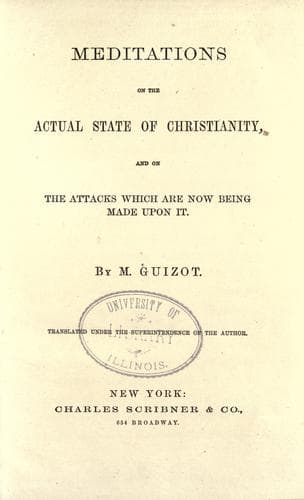
Meditations on the Actual State of Christianity, and on the Attacks Which Are Now Being Made Upon It.Guizot, François
Religion
Meditations on the Actual State of Christianity, and on the Attacks Which Are Now Being Made Upon It.
Guizot, François
Christianity; Philosophy and religion; Religious thought -- 19th century
have not collected with care all the principles and facts which
are actually there."
{358}
Having thus formalized the question, M. Royer-Collard follows it
up with an inquiry as exact as it is profound, of the
psychological fact of the perception of the external world which
accompanies the fact of sensation: this inquiry leads him to this
conclusion:
"Sensation has no object; sensation is merely relative to the
sentient being; if not perceived, sensation does not exist. But
the perception, which affirms an external existence, supposes
two things--the mind which perceives, and the object which is
perceived; the being that thinks, and the being that is the
subject-matter of thought. Just as the sensation is relative to
the mind, so is the act of the perception relative to it also,
and just so does it suppose the mind; the object, on the
contrary, supposes neither the mind nor the mind's perception.
{359}
The object does not exist because we perceive it; but we
perceive it because it exists--because we are endowed with the
faculty of perception. In a city inhabited no longer, there
remain no sensation, no idea, no judgment; the houses remain,
and even the streets, and with them nature, with all nature's
laws, which are not suspended in their course. To the universe,
the energetic presence of its Creator suffices; it does not
require our presence; the absence of spectators would not make
it languish; it existed before us, it will exist after us; its
reality is independent of us and of our thoughts--it is
absolute. The authority which persuades us of this is no less
than that of the consciousness itself; it is the authority of
the primitive laws of thought, and to man's mind those laws are
absolute laws of truth. The same draught may convey the
impression of sweetness and of bitterness, because sensation is
relative to the variable state of sensibility, and sensibility
itself is relative to organization; but the laws of the mind
are an immutable standard.
{360}
The imperfection of knowledge does not render it uncertain, and
although it admits of degrees, it does not admit of
contradiction. Our limited faculties do not, it is true,
perceive all that there is in things; but still, what they do
perceive, is in effect there just as they perceive it. ...
If a man call upon me to prove this by reasoning, I shall, in
my turn, demand of him, too, that he first prove to me by
reasoning that reasoning is more convincing than perception;
that he at least prove that the memory, without which there is
no such thing as reasoning, is a faculty more to be relied upon
than those faculties whose testimony they reject.
Public-domain text, read in full here on John Shaqi.
Reviews
Reviews
No reviews yet
Be the first to share your thoughts on this work.
Elsewhere in the archive
Join the Discussion
Join the discussion
Sign in to leave a comment or review.
Sign InorCreate an account