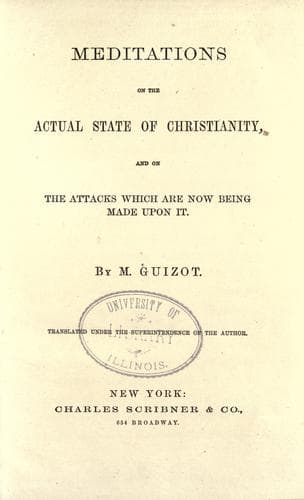
Meditations on the Actual State of Christianity, and on the Attacks Which Are Now Being Made Upon It.Guizot, François
Religion
Meditations on the Actual State of Christianity, and on the Attacks Which Are Now Being Made Upon It.
Guizot, François
Christianity; Philosophy and religion; Religious thought -- 19th century
they refuse to it the right to affirm as real, out of the mind
and in itself, that which, in the mind and for the mind, the mind
yet admits to be true.
The human being may deceive himself, and often does deceive
himself in such or such a special affirmation as to external
realities; it has of them only a knowledge incomplete, and liable
to error; but its general and permanent affirmation as to their
existence is still folly justified and legitimate; it knows them
as it knows itself, by the same proof and by the same natural
process. M. Royer-Collard expresses admirably this great fact
when he says: "The universe does not exist because we perceive
it; but we perceive it because it exists. ... It needs not our
presence; the absence of spectators would not make it languish
away; it was before us, it will still be after us; its reality is
independent of us: it is absolute."
{367}
Systematic skepticism is not, like Materialism and Pantheism, an
hypothesis invented, although unsuccessfully invented, in order
to solve the grand problem of soul and body, of finite and
infinite; its error is not less considerable, although of a
different character. It consists in a defective examination of
the primitive fact of the human mind, and in the misapprehension
of the nature and the import of that fact. This fact is by no
means, as M. Jouffroy affirms, "a faith blind and irresistible,"
disavowed by rational science; it is really the natural
knowledge, and the earliest knowledge acquired by the human being
when it enters into activity; a knowledge, confused and
incomplete, either of itself or of what is not itself; but still
a knowledge direct and certain of the existence of itself, and of
the existence of what is not itself. "Man believes by instinct
and doubts by reason," adds M. Jouffroy; "skeptics obey the law
of their instinctive nature when they believe, like the mass of
mankind, in their senses, their consciousness, their memory, and
when they act in consequence; so also they obey their rational
nature when they confess that their beliefs are illegitimate."
{368}
This is strangely to _ignore_--I permit myself the use of
this, here, incorrect expression--at once the reality of facts,
and the value of words. What M. Jouffroy terms _instinct_,
is the intuitive consciousness of internal reality and of
external reality, and this consciousness the human being acquires
directly by the complete and indivisible exercise of all his
faculties; what he terms _reason_ is the result of the
isolated operation of one of the faculties of the human being,
who virtually forgets, when he decomposes himself for his own
study, what he really is. Skepticism is not the "final word of
the reason respecting the reason;" it is the suicide of the
reason by a negation falsely termed scientific, of natural
evidence, and of the common sense of mankind.
---------------------------------------
{369}
Eighth Meditation.
Impiety, Recklessness, And Perplexity.
Public-domain text, read in full here on John Shaqi.
Reviews
Reviews
No reviews yet
Be the first to share your thoughts on this work.
Elsewhere in the archive
Join the Discussion
Join the discussion
Sign in to leave a comment or review.
Sign InorCreate an account