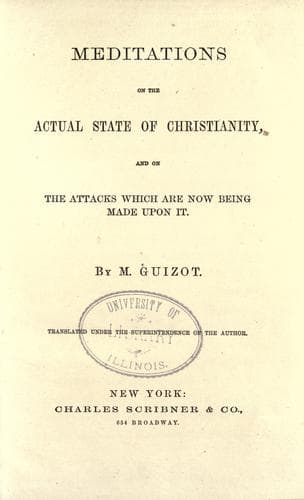
Meditations on the Actual State of Christianity, and on the Attacks Which Are Now Being Made Upon It.Guizot, François
Religion
Meditations on the Actual State of Christianity, and on the Attacks Which Are Now Being Made Upon It.
Guizot, François
Christianity; Philosophy and religion; Religious thought -- 19th century
I retrench nothing, change nothing in these remarkable words that
express so energetically the conclusions of the common sense of
mankind. I would only render them still more complete, by
illustrating in its primitive and indestructible unity the fact
upon which they are founded. "We cannot divide man," says M.
Royer-Collard. Here is precisely the risk that philosophical
science incurs, and to which it too often succumbs. It divides
man in order to study him; and after having so studied him, when
it seeks to deduce from its laborious operation what man in his
complete and living reality is, we find the result a strange
misapprehension, because science has neglected to re-establish
the unity which it broke.
{364}
It puts together, it is true, the scattered members, but the
being itself has disappeared; and then it is that philosophers
know not how to solve the problems or to extricate themselves
from the doubts by which they are confronted. Entire, living,
one, the human being explained himself; mutilated and severed
into distinct parts, that being loses all power and falls into
obscurity.
What is sensation, what perception, judgment, reasoning, reason,
will, consciousness? They are the human being, feeling,
perceiving, judging, reasoning, willing, and observing what is
passing within him. This is no troop of actors playing, each his
part, in a complex drama; but a being single and alive, actor and
sole spectator in the drama of his proper life.
What is this one and single being doing when he feels, perceives,
judges, reasons, wills, and watches what is occurring within
himself? He is taking cognizance at once of himself, and what is
not himself.
{365}
His own existence and the existence of that which is not himself,
reveal themselves to him from the very first in those diverse
facts and acts which philosophical science discriminates, and
calls by the particular names of sensation, perception, judgment,
reason, will, consciousness. The primitive and essential fact at
the root of all, is the fact itself of the cognizance which man
takes of himself, and of what is not himself. A cognizance, at
first confused, and always incomplete, but at the same time
direct and certain. Not by way of deduction, nor as a mere
appearance, but by way of immediate intuition, and as a positive
reality, does the human being become aware of his own existence
and of that existence which is not his. This fact is lost sight
of, or at least is not characterized exactly and as it is in
itself, when it is said that man believes naturally and
inevitably in his own existence, and in that of the external
world. This is a very different thing from _belief:_ it is
_knowledge_ itself of that double reality, internal and
external, called by the name of Man and World.
{366}
Philosophers ignore, and they change the nature of this fact,
when, merely playing with verbal distinctions and reasonings,
they condemn the human mind not to issue forth from itself, when
Public-domain text, read in full here on John Shaqi.
Reviews
Reviews
No reviews yet
Be the first to share your thoughts on this work.
Elsewhere in the archive
Join the Discussion
Join the discussion
Sign in to leave a comment or review.
Sign InorCreate an account