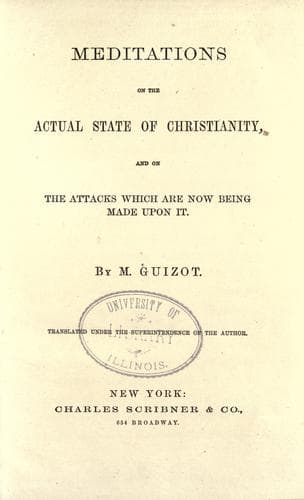
Meditations on the Actual State of Christianity, and on the Attacks Which Are Now Being Made Upon It.Guizot, François
Religion
Meditations on the Actual State of Christianity, and on the Attacks Which Are Now Being Made Upon It.
Guizot, François
Christianity; Philosophy and religion; Religious thought -- 19th century
In this condition, so new to France, the situation of the Jesuits
was embarrassing and perilous. Napoleon was again re-establishing
the Church of Rome, and at the same time enforcing the maxims of
Absolutism--a double title to their sympathy. On the other hand,
he was consolidating the Revolution, and maintaining and putting
into practice some of its essential principles, among others,
that of freedom of conscience. Napoleon arrogated also to himself
the right of dictating and acting as master in the Church as in
the State, at Rome as at Paris; he was neither a serious believer
in the faith of Christ nor a sure friend of the Papacy. In this
twofold aspect, the Jesuits could not but regard him with
distrust. The distrust was mutual: for if Napoleon was for the
Jesuits a too faithful and too ambitious heir of the Revolution,
the Jesuits were for him Catholics too independent and too
devoted to their Church and to its chief. As far back as 1804,
their establishments, scarcely disguised under different names,
had been a source of disquietude to Napoleon.
{41}
He directed them to be closed, enforced the laws which denied to
religious corporations an independent existence, and founded the
University, which at the same time he invested with the privilege
of teaching. This system was not abolished at the Restoration.
The Jesuits then entered into the simultaneous possession of two
forces novel to them--the one sprang from the support of power,
the other was derived from the progress of liberty. They had the
favor of the court, and might wield as their own arms, and in
their own interests, the liberal principles that were dear to the
people. A position excellent, had they known how to restrict
themselves to their religious mission, keep aloof from political
contests, and devote themselves exclusively to the task of
awakening the faith of Christians, and arousing them to a
Christian life! Their action upon the soul might have extended
their influence beyond their peculiar sphere to the world
without. Had they not then a striking instance of such an
influence even in their own order?
{42}
To what cause, thirty years ago, did the Père Ravignan owe the
respect and moral authority with which he was surrounded, not
only by members of his own Church, but by men not remarkable for
their faith? Far less to his talent as an orator, than to the
thorough sincerity and disinterestedness of his religious
character. He was a believer, a pious Christian, and a stranger
to every mental reservation; neither was he a partisan, but
solely occupied with the service of God, of his Church, and of
his order, at the same time that he was propagating the faith and
enforcing piety. He declared himself aloud a Jesuit, but the
declaration excited no distrust even in his adversaries. If his
order had imitated his example, it would have obtained a similar
success. Nor was the instance new. In the seventeenth century, at
Public-domain text, read in full here on John Shaqi.
Reviews
Reviews
No reviews yet
Be the first to share your thoughts on this work.
Join the Discussion
Join the discussion
Sign in to leave a comment or review.
Sign InorCreate an account