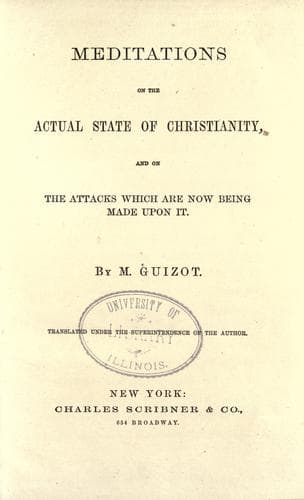
Meditations on the Actual State of Christianity, and on the Attacks Which Are Now Being Made Upon It.Guizot, François
Religion
Meditations on the Actual State of Christianity, and on the Attacks Which Are Now Being Made Upon It.
Guizot, François
Christianity; Philosophy and religion; Religious thought -- 19th century
The Abbé Lacordaire had soon to feel the danger and to repel with
sorrow the yoke of this seductive friendship. The errors and the
evil passions of the Abbé de la Mennais were not long in
exploding; his was a mind lofty and powerful, but without grasp,
without foresight, without moderation, and without equity;
incapable of discerning the different sides of a subject and of
embracing all the elements of the problem demanding solution, he
was a haughty slave to the truth that he served but partially,
and the somber enemy of every one who wounded his pride by
contesting his opinions.
{48}
He gave to the _Avenir_ a character at once democratic and
theocratic, imperious and revolutionary. All the ideas contrary
to his own, all the institutions, all the governments, that stood
in his way, were attacked by him with a degree of vehemence,
insult, and menace never surpassed by any political partisan,
however violent. The maxims of the Gallican Church were, to cite
his words, "an object of disgust and horror; opinions as odious
as they were base, which, while rendering even the conscience the
accomplice of tyranny, make servility a duty and brute force an
independent and just right." He demanded the separation of Church
and State as a necessity absolute and urgent; "for," said he, "we
regard as abolished and of no effect every particular law which
contradicts the Charter, and is incompatible with the liberties
that _it_ proclaims.
{49}
In the event of such law, we believe that it becomes immediately
and without delay the duty of government to come to an
understanding with the pope, and to rescind the Concordat, which
lost all the means of being executed from the instant when, thank
God, the Catholic religion ceased to be a state religion." Four
months had scarcely elapsed since the birth of the government of
July, and because the liberty of teaching promised by the Charter
of 1830 was not already in vigor, the Abbé de la Mennais said to
the Catholics: "Whence comes the oppression that weighs upon us?
Either, in what concerns us, the government cannot or it will not
keep its promises. If it cannot, what is this mockery of a
sovereignty, this miserable phantom of government, and what have
we to do with it? It is as far as we are concerned as if it were
_not_, and nothing remains to us but to forget it, and seek
our safety in ourselves.
{50}
Let us proclaim aloud who the powers are that are hostile to us;
whose servants seek only to satisfy blindly their thirst for
persecution." What attacks leveled at a government were ever more
precipitate, more violent, and showed a less just appreciation of
facts? What revolutionary party ever proclaimed with greater
audacity disobedience to the laws, and insurrection as the first
of rights and of duties?
Public-domain text, read in full here on John Shaqi.
Reviews
Reviews
No reviews yet
Be the first to share your thoughts on this work.
Join the Discussion
Join the discussion
Sign in to leave a comment or review.
Sign InorCreate an account