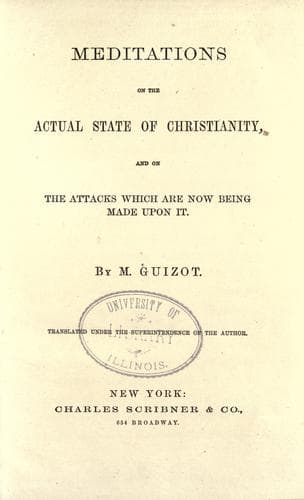
Meditations on the Actual State of Christianity, and on the Attacks Which Are Now Being Made Upon It.Guizot, François
Religion
Meditations on the Actual State of Christianity, and on the Attacks Which Are Now Being Made Upon It.
Guizot, François
Christianity; Philosophy and religion; Religious thought -- 19th century
In this sudden subversion of all things, in the presence of a
republic extemporized upon the ruins of three monarchies--the
monarchy of glory, the monarchy of tradition, and the monarchy of
public opinion--in the midst of this nation, suddenly insurgent
and beyond either its aim or expectation sovereign, what became
of the Church? What did its ministers? If some of them
participated in the current dreams, certainly the majority were
full of anguish and alarm; they did not combat the new
institutions; they did not pretend to exercise any influence for
or against any party; they sought only to purify the Republic by
securing in it a place for Religion; they did not stand aloof
from the people; they showed themselves, in its great assemblages
and in its fêtes, planting the cross of Jesus by the side of the
tree of liberty.
{101}
Never did the Church stand so aloof from politics; never was she
more modest in her attitude; never less exacting--I will not say
more obsequious, as far as the Government or the public was
concerned; never more absorbed with her mission of piety and
morality, whatever the Government of France might be, and whoever
her masters.
And what in their turn was the conduct of the people toward the
Church? I do not mean to say that they confided in her, or showed
her much affection. The popular movement in 1848 was no doubt far
from being religious; and the ideas, acts, and language which
proceeded from it every instant, were well calculated to disturb
and sadden the hearts of Christians; but religion and its
ministers were in no respect ill treated, insulted, or
persecuted; their forms of worship were not interrupted: when
they showed themselves out of doors, they were received with
respect; and at the sight of a virtuous archbishop mortally
wounded in the streets, in the very endeavor to appease the civil
war by the exhibition of the cross, a painful stupor seized the
people; a pang of remorse and of shame traversed those masses of
disbelievers at the sight of a martyr.
{102}
It was clear that in the interval between 1830 and 1848, although
the Christian Church had not aroused in the people either faith
or sympathy, that Church had at least won liberty and peace. When
the revolutionary fever had subsided, when the Republic had given
itself a chief, and was waiting for a master, it was no longer in
the street, by popular impressions, but in the Assemblies, and by
the constituted authorities, that the great questions of the day
were put and were solved. There, too, the progress, which the
Catholic Church had made, became immediately evident, and its
gains were ascertained. It counted at this moment among its most
zealous servants a man new to public affairs, who had entered
political life as an adherent of the Legitimist Opposition to the
Monarchy of 1830, a man who accepted the Republic, and had
acquired in a few days a just renown by his courageous resistance
to anarchy.
{103}
Public-domain text, read in full here on John Shaqi.
Reviews
Reviews
No reviews yet
Be the first to share your thoughts on this work.
Elsewhere in the archive
Join the Discussion
Join the discussion
Sign in to leave a comment or review.
Sign InorCreate an account