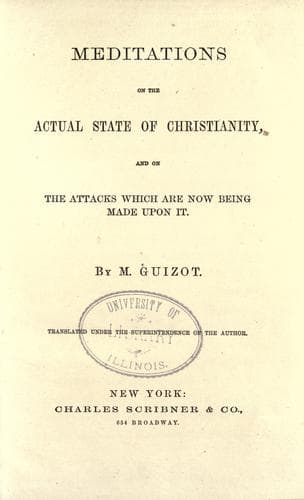
Meditations on the Actual State of Christianity, and on the Attacks Which Are Now Being Made Upon It.Guizot, François
Religion
Meditations on the Actual State of Christianity, and on the Attacks Which Are Now Being Made Upon It.
Guizot, François
Christianity; Philosophy and religion; Religious thought -- 19th century
By a choice, fortunate but at the same time unforeseen, M. de
Falloux became the Minister of Public Instruction and of Worship
in the first cabinet formed by the Prince President of the
Republic. The new minister immediately devoted himself to the
important measure that the Catholic Church had had in view ever
since the year 1830, that is, to the complete establishment,
under the sanction of the law, of the principle of liberty of
instruction. He proceeded in his task at once with intelligence
and boldness. To prepare his project of law, he appointed a
numerous commission, and summoned to it the most eminent men, who
represented views and interests the most diverse; laymen and
ecclesiastics, Romanists, Protestants and philosophers,
Republicans, Legitimists, Orleanists and Bonapartists, M. Thiers
and the Abbé Dupanloup, M. Cousin and M. de Montalembert, M.
Saint Marc Girardin and M. Cochin, M. Cuvier and the Abbé Sibour.
[Footnote 12]
[Footnote 12: The following is a complete list of the members
of the Commission, as given in the "Moniteur" of the 22d
June, 1849: M. Thiers, president; MM. Cousin, St. Marc
Girardin, Dubois, the Abbé Dupanloup, Peupin, Janvier,
Laurentie, Freslon, Ballaguet, de Montalembert, Fresneau,
Poulain de Bossay, Cuvier, Michel, Armand de Melun, Henri de
Riancey, Cochin, the Abbé Sibour, Roux-Lavergne, de
Montreuil-Housset, and Alexis Chevalier, secretary.]
{104}
M. Thiers was the president of this commission, which sat during
five months. It discussed every question respecting the
organization of public instruction with a passionate ardor, and,
at the same time, with an earnest and sincere desire to
conciliate, by their resolutions, all opinions. According to the
character of the times and the state of public sentiment,
critical and perilous situations precipitate men sometimes to the
commission of insane acts of violence, and sometimes keep them
within the line of fairness and prudence. The project of law
which issued from the commission of M. de Falloux had the merit
of prudence.
{105}
In making mutual concessions, the representatives of the
different systems took good care to protest that they did not
renounce their peculiar principles--a language which made
sometimes their resolutions have the air of a superficial and
incoherent compromise; but men could, nevertheless, observe how
conspicuous that project was for its large and practical
character, and its respect for different rights; and they could
also see how the State, the Church, and private establishments
were left free to compete in matters of public instruction. When
this project was discussed in the Legislative Assembly, M. de
Falloux was no longer minister; but the impulse had been given,
and his measure was out of danger; his successor, M. de Parien,
too, gave it the support which it deserved; and after a
discussion which occupied thirty-seven sittings, the Assembly, by
Public-domain text, read in full here on John Shaqi.
Reviews
Reviews
No reviews yet
Be the first to share your thoughts on this work.
Elsewhere in the archive
Join the Discussion
Join the discussion
Sign in to leave a comment or review.
Sign InorCreate an account