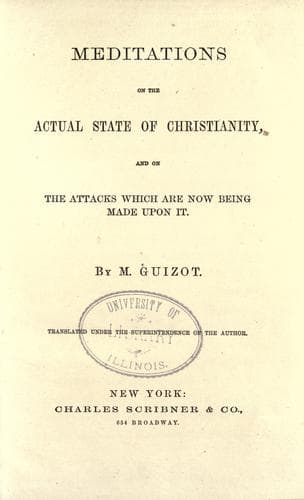
Meditations on the Actual State of Christianity, and on the Attacks Which Are Now Being Made Upon It.Guizot, François
Religion
Meditations on the Actual State of Christianity, and on the Attacks Which Are Now Being Made Upon It.
Guizot, François
Christianity; Philosophy and religion; Religious thought -- 19th century
No such embarrassment was experienced by M. Daniel Encontre when
he began his career to serve the movement of awakened
Christianity in the bosom of French Protestantism. I will not
venture here to cite the precise words, harsh and severe,
employed by him on the 13th of December, 1816, at Montauban, in
his capacity of "Doyen" of the faculty of Protestant Theology,
respecting those termed by him "the pretended ministers of the
Gospel, disbelievers in the Gospel and in the divinity of Jesus
Christ."
{139}
He regarded harmony of faith and language, harmony between
shepherd and flock, as the first law of religious society. Born
in a grotto of La Vaunage, to which his mother had fled to escape
from the flames of persecution; devoted from his birth by his
father, the Pastor Pierre Encontre, to the service of a "preacher
in the desert," M. Daniel Encontre belonged to that class of
indomitable Protestants who cling to their faith through all the
perils, sufferings, and sacrifices which it entails. His first
steps in life seemed to indicate in him other aptitudes, and to
promise for him a different career. After having studied divinity
at Lausanne and at Geneva, and been consecrated by his father
himself to the ministry of the Gospel "in an assembly in the
desert," he seemed to doubt his own vocation; for while
performing the functions of his ministry he devoted himself to
the study of mathematics, physics, philosophy, and the classical
languages, with an enthusiasm eager to become familiar with every
department of knowledge, and encountering no hinderance from,
internal obstacles or from preconceived opinions.
{140}
Having established himself at Montpellier, where his taste for
science found subjects of gratification, he led there, during the
dark days of the Revolution, a life very obscure, and at the same
time most laborious; giving lessons to the master masons upon
stone-cutting, imparting instruction, rendering the aids of
religion to Protestants, celebrating the baptismal and marriage
services, and pursuing at the same time his labors in geometry,
botany, philosophy, divinity, literature, and even poetry. When
order began to be re-established, he was led by his own natural
tastes and the counsel of his friends to select as his career
that of public instruction. He competed for and obtained, first
the appointment of professor of literature at the École Centrale
of Montpellier; then that of the higher mathematics, at the Lycée
and in the faculty of science, of which he was nominated "Doyen."
{141}
As his merits established themselves by repeated proofs, his
reputation increased; the papers of learned societies were filled
with his contributions, and the École Polytechnique with his
pupils. "I have met in our department," said Fourcroy, "two or
three heads equal to his, but not one superior." M. de Candolle
gladly selected him to aid him in his "Researches respecting the
Botany of the Ancients;" and M. de Fontanes has more than once
Public-domain text, read in full here on John Shaqi.
Reviews
Reviews
No reviews yet
Be the first to share your thoughts on this work.
Elsewhere in the archive
Join the Discussion
Join the discussion
Sign in to leave a comment or review.
Sign InorCreate an account