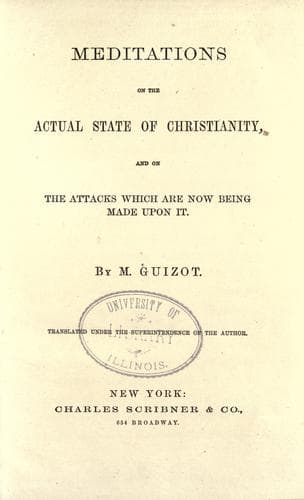
Meditations on the Actual State of Christianity, and on the Attacks Which Are Now Being Made Upon It.Guizot, François
Religion
Meditations on the Actual State of Christianity, and on the Attacks Which Are Now Being Made Upon It.
Guizot, François
Christianity; Philosophy and religion; Religious thought -- 19th century
spoken of him to me as one of the men who most honored the
University. But in him, neither the mathematician, the botanist,
nor the philologist took precedence of the Christian. At one time
as expounder of Moses and of Genesis, [Footnote 18] at another as
a writer defending the Apostles, accused of being a copyist of
Plato. [Footnote 19] he neglected no occasion of placing his
scientific attainments at the service of Christianity;
[Footnote 18: Dissertation sur le vrai système du monde
comparé avec le récit que Moïse fait de la création.
Montpellier, 1807.]
[Footnote 19: Lettre à M. Combes-Dounous, auteur d'un Essai
historique sur Platon. Paris, 1811.
A remarkable essay of M. Daniel Encontre, "sur le Péché
original," was published, after his death, in 1822, and he
left a great number of manuscripts, among others a "Traité
sur l'Église," (600 pages,) written in Latin; "Etudes
théologiques," a Hebrew Grammar, a "Cours de philosophie," a
"Cours de litérature Française," a "Flore biblique," several
"Memoires de mathématiques transcendantes," etc. As a teacher
of transcendental mathematics at Montpellier he had as pupil
M. Auguste Comte, the head of the "École positiviste," who,
in spite of the profound diversity of their opinions,
regarded it as a duty to dedicate to him in 1856 his
treatise, "Sur la Synthèse subjective," in testimony of
admiration and of gratitude.]
{142}
and when, in 1814, he was asked to quit Montpellier, to abandon
his habits, his tastes, and his friends, for the chair of the
professorship of divinity at Montauban, where he was to fulfill
the functions of "Doyen," he sacrificed without hesitation the
enjoyment of his life to his religious vocation, and applied
himself with unceasing energy to the warlike activity of a
Christian professor, until the day when, overcome by fatigue and
sickness, he accorded to himself the melancholy satisfaction of
returning to Montpellier, in order to die near the tomb of a
beloved daughter, who had long aided him in his labors.
{143}
Public-domain text, read in full here on John Shaqi.
Reviews
Reviews
No reviews yet
Be the first to share your thoughts on this work.
Elsewhere in the archive
Join the Discussion
Join the discussion
Sign in to leave a comment or review.
Sign InorCreate an account