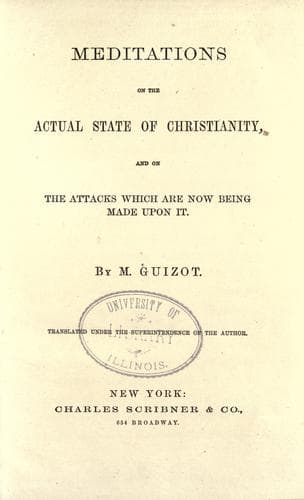
Meditations on the Actual State of Christianity, and on the Attacks Which Are Now Being Made Upon It.Guizot, François
Religion
Meditations on the Actual State of Christianity, and on the Attacks Which Are Now Being Made Upon It.
Guizot, François
Christianity; Philosophy and religion; Religious thought -- 19th century
The destinies of Protestantism in France have, to a singular
degree, been at once varied and uniform, confused and simple.
After having in the sixteenth century valiantly disputed the
victory, it was vanquished, decimated, expelled. But it resisted,
and survived not only its defeat, but the gradual process of its
enfeeblement and its expulsion. In the course of the seventeenth
and eighteenth centuries the French Protestants lost the
protection of the laws, their secure sanctuaries, their great
chiefs, their great divines, their great writers; but they
preserved nevertheless their faith and their religious honor. In
the times that ensued their successors remained faithful to the
belief and the customs of their fathers; even persecuted and
condemned to death, having their property confiscated, or become
tenants of prisons and laborers in the galleys, they found in
their very sufferings a resource to confirm them in the
principles of Protestant piety.
{144}
Theological controversies died away from among them, leaving
behind them the fundamentals of Christianity--living and guiding
principles.
Among the higher and wealthier classes, the philosophical ideas
of the eighteenth century made also their way; the great liberal
movement filled the Protestant section of the nation with joy,
and commanded its sympathy without detaching it from its
religious habits and traditions. In its members faith had ceased
to be erudite; the popular Protestant sentiment had been always
profoundly biblical and evangelical. Freer and more fortunately
situated than their fathers, the French Protestants now anxiously
desired to remain, as they had been, Christians; and when, in
1790, Rabaut Saint-Etienne, who succeeded the Abbé de Montesquieu
as President of the Constituent Assembly, wrote to his aged
father, the Pastor Paul Rabaut, "The President of the National
Assembly is at your feet," he manifested to the humble and
zealous preacher in the assemblies of the desert, the pride at
once of a politician, the piety of a son, and the fidelity of a
Protestant.
{145}
M. Daniel Encontre was, at the commencement of the nineteenth
century, the faithful representative of this traditionally
religious character of French Protestantism; just as M. Samuel
Vincent was the well-meaning and sincere introducer to it of the
science and criticism of the Germans. The former corresponded
more closely to the pious and national spirit of Protestant
France of the olden times; the latter to the tendencies, at once
novel and indefinitely latitudinarian, of a foreign philosophy
and a foreign erudition. Doubtless, neither measured the range of
the religious crisis of which they were themselves the symptoms;
neither foresaw that within the bosom of Protestantism that
crisis was to be marked by an avowed struggle between Rationalism
in its progress and Christianity in its reaction.
{146}
Public-domain text, read in full here on John Shaqi.
Reviews
Reviews
No reviews yet
Be the first to share your thoughts on this work.
Elsewhere in the archive
Join the Discussion
Join the discussion
Sign in to leave a comment or review.
Sign InorCreate an account