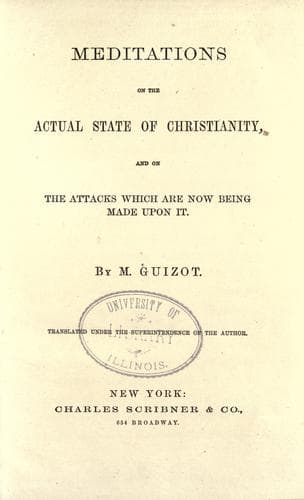
Meditations on the Actual State of Christianity, and on the Attacks Which Are Now Being Made Upon It.Guizot, François
Religion
Meditations on the Actual State of Christianity, and on the Attacks Which Are Now Being Made Upon It.
Guizot, François
Christianity; Philosophy and religion; Religious thought -- 19th century
M. Adolphe Monod seemed, even more than M. Vinet, to promise by
natural bent of his character, and by the incidents of his life,
to become the champion of an entire separation of Church and
State. At the very commencement of his career, he suffered from a
Government based upon their connection. Pastor at Lyons, in 1831,
of the established Protestant Church, he was dismissed from these
functions by the Consistory of that city, as too exacting in his
orthodoxy, and as troubling by his exigencies the peace of his
Church. He then became the founder and pastor of a small
dissenting and independent Church at Lyons. The energy with which
he expressed his convictions, and the excellence of his
preaching, rapidly spread, and increased his renown for piety.
Numerous Protestants manifested the desire to see him once more
within the pale of the national Church. He made no objection; a
Chair becoming vacant in the Faculty of Montauban, M. Adolphe
Monod was nominated, and from 1836 to 1847 he both lectured and
preached at Montauban with a commanding ability that made itself
felt, not only among the majority of the students, but propagated
its influences to a distance among the principal centers of
French Protestantism.
{188}
In 1847 he was summoned to Paris as the suffragan of another
pastor, M. Juillerat. Nor did he scruple to accept this secondary
and precarious situation. He had full confidence in the divine
vocation, and was firmly resolved to proceed to any place where
the faith of Christ might demand his services. He had, in the
evangelical chair, even more success at Paris than at Lyons and
Montauban. When, after the Revolution of 1848, a general assembly
of the Reformed Churches of France assembled for the purposes of
considering their institutions and discussing points of common
interest, a grave question was raised, and became the subject of
warm and lengthened debate: Should French Protestants proclaim
their ancient Confession of Faith, that of Rochelle, or should
they proclaim a confession of new articles; or lastly, should
they remain passive and do nothing? some, and particularly their
pastor, M. Frederic Monod, elder brother of M. Adolphe Monod,
announced their determination to retire from the assembly and
from the established Church, unless they adopted a Confession of
Faith in accordance with the traditional principles of the
Reformation.
{189}
The inertness of the hesitating and timid assembly was equivalent
to a refusal, and they did in effect retire. To the great
surprise and great regret of his adversaries, M. Adolphe Monod,
although favorable to the principles of the Confession of Faith,
did not follow the example by retiring; he even succeeded his
brother as titular pastor in the Church of Paris, and published
to the world the motives of his conduct. [Footnote 28]
[Footnote 28: In his work entitled, Pourquoi je demeure dans
l'Église établie.]
{190}
Public-domain text, read in full here on John Shaqi.
Reviews
Reviews
No reviews yet
Be the first to share your thoughts on this work.
Elsewhere in the archive
Join the Discussion
Join the discussion
Sign in to leave a comment or review.
Sign InorCreate an account