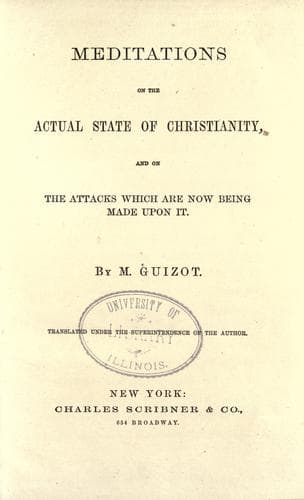
Meditations on the Actual State of Christianity, and on the Attacks Which Are Now Being Made Upon It.Guizot, François
Religion
Meditations on the Actual State of Christianity, and on the Attacks Which Are Now Being Made Upon It.
Guizot, François
Christianity; Philosophy and religion; Religious thought -- 19th century
His motives were good, such as a man of elevated character and
energetic purpose might conceive and might avow. In spite of
their importance, the questions which concern the organization of
the Church and its eternal relations were, in the eyes of M.
Adolphe Monod, only secondary considerations, subject in a
certain measure to time and to circumstance. For him the question
of faith was supreme; and he occupied himself infinitely more
with the spiritual state of souls than with ecclesiastical
government. To the serious thinker the Christian faith is quite
different from any conception or conviction of the understanding;
it is a general condition of the whole man; it is the very life
of the soul; not merely its actual life, but the source and the
guarantee of its future life. The faith in Christ Jesus, the
Redeemer, the Saviour, makes the life of a Christian; and the
life of a Christian is a preparation for an eternal salvation.
With this faith penetrating to his very marrow, and with the
intimate persuasion of its consequences, the duty of giving a
voice to that faith, and of diffusing it, was the dominant idea,
the permanent passion, of M. Adolphe Monod.
{191}
He had not himself been always firmly settled in his religious
convictions; he had been a prey to great moral perplexities, and
to attacks of profound melancholy. When he had escaped from
these--or rather, to use his own words, "when God had become
really the master of his heart"--he had no other thought but that
of bringing other souls to the same state, and of rousing them to
a faith in Christ, with a view to their eternal salvation. The
position which he regarded as of all the most appropriate for
himself, was one in which he could most profitably forward this
work. When in 1848 the question was thus put to him, and when he
had been convinced both by his past observation of the Protestant
Church of France during the last twenty years, and by his own
experience of it, that the established Church offered to him in
his Christian purpose the vastest field of exertion, and the best
chance of success, he did not hesitate to remain in it. "I find
in the situation," he said, "grave disorders, of which it is my
duty to seek unceasingly the reform; but that situation has also
its hopeful side.
{192}
A long development of my ideas would be superfluous; let us
confine ourselves to some striking facts. Try and reckon how many
orthodox pastors our Church possessed when the reaction began in
1819, and then make a similar calculation for 1849. I do not mean
to fix the precise numbers; but is it too much to say, that in
the course of a single generation the number of orthodox pastors
is ten, fifteen, twenty times perhaps as great? This applies to
the clergy, of whom everywhere the immense influence is felt.
Among their congregations it is less easy to follows things; but
the attentive observer does not fail to mark similar indications.
Behold our religious societies: are not the most popular among
Public-domain text, read in full here on John Shaqi.
Reviews
Reviews
No reviews yet
Be the first to share your thoughts on this work.
Elsewhere in the archive
Join the Discussion
Join the discussion
Sign in to leave a comment or review.
Sign InorCreate an account