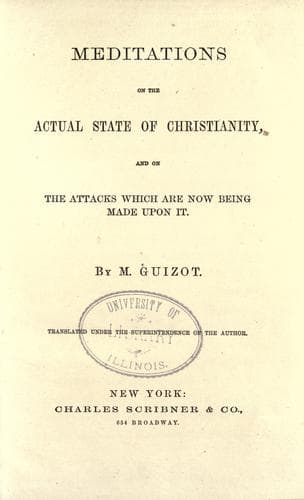
Meditations on the Actual State of Christianity, and on the Attacks Which Are Now Being Made Upon It.Guizot, François
Religion
Meditations on the Actual State of Christianity, and on the Attacks Which Are Now Being Made Upon It.
Guizot, François
Christianity; Philosophy and religion; Religious thought -- 19th century
sixteenth century was prodigal, they make dogmas of only a small
number of fundamental doctrines. And even of these they strive to
contract the circle, until having reached the vital forces, the
very heart, so to say, of truth, they sum it up in one single
name, Jesus Christ, and in one single word, grace.
{196}
Whoever is of that faith, whatever name he bears elsewhere, and
whatever place he occupies in the Universal Church--Lutheran,
Anglican, Methodist, Moravian, Baptist, nay, Roman Catholic, or
Greek Catholic, we receive that man as a brother in Christ Jesus;
and not we only, but the whole contemporary Evangelical Church,
with certain exceptions becoming every day rarer, and arising
from a narrow or sectarian pietism. Hence the 'Evangelical
Alliance,' formed in our own time of more than twenty Protestant
denominations, the prelude only to another evangelical alliance
which will exclude none who rely upon the sole merits of Jesus
Christ, the Saviour and Lord of all.
"Our '_exclusisme_,' besides, has not for its objects
individuals but doctrines. Absolute affirmation is legitimate
when the object is to define the faith, which is the promise of
salvation, for God has clearly revealed it in his word; but when
the object is to mark the individuals who possess that saving
faith, similar affirmation could not be used without temerity;
for God has nowhere revealed to us either the internal state of
any man, or the final lot reserved for him.
{197}
_We_ exclude no man, _we_ judge no man, alive or dead;
the judgment of the quick and of the dead belongs to God alone.
Doubtless we estimate, according to our ability, the spiritual
condition of a man by his works, as we do a tree by its fruits;
Jesus himself invites us to do so. Doubtless, when we see a man
living and dying in the works of the faith, we hope for him, and
our hope may grow even to a firm assurance; and when, on the
contrary, we see a man living and dying in the works of
incredulity, we have a feeling of anxiety for him--a feeling as
painful as it is mysterious. But, after all, neither in the first
case nor in the second, and still less in the second than the
first, are we authorized to pronounce any personal judgment; and
but for the paradoxical turn of the expression, I would willingly
adopt the language of the devout Bunyan: Three things would
astonish me in heaven; first, not to see there certain persons
whom I expect to see there; secondly, to see there those I do not
expect to see there; and thirdly, which would surprise me most,
to see myself there.'" [Footnote 30]
[Footnote 30: Sermon sur l'Exclusisme, ou l'unité de la foi,
in the Recueil des Sermons de M. Adolphe Monod. 3me série, t.
ii, pp. 386-390. Paris, 1860. The sermons of M. Adolphe Monod
have been collected and published in four vols. 8vo. Paris,
1856-1860. He also wrote several small works, among others:
1. Lucile, ou la lecture de la Bible. 1841.
Public-domain text, read in full here on John Shaqi.
Reviews
Reviews
No reviews yet
Be the first to share your thoughts on this work.
Elsewhere in the archive
Join the Discussion
Join the discussion
Sign in to leave a comment or review.
Sign InorCreate an account