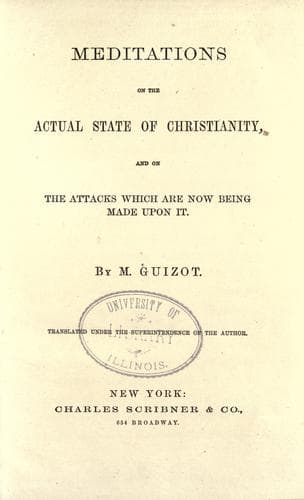
Meditations on the Actual State of Christianity, and on the Attacks Which Are Now Being Made Upon It.Guizot, François
Religion
Meditations on the Actual State of Christianity, and on the Attacks Which Are Now Being Made Upon It.
Guizot, François
Christianity; Philosophy and religion; Religious thought -- 19th century
2. La Destitution d'Adolphe Monod, récit inédit, rédigé par
luimême. 1864.
3. Récit des conférences qui ont eu lieu en 1834, entre
quelques Catholiques Remains et M. Adolphe Monod. Paris,
1860.
4. Les adieux d'Adolphe Monod à ses amis et à l'église.
Paris, 1856.]
{198}
A piety so profound, and at the same time so modest and so large,
expressed with an eloquence which combined an impassioned
earnestness of language with an impassioned earnestness of
conviction, could not fail to exercise great influence. As a
preacher, M. Adolphe Monod was powerful.
{199}
He had acquired, not by careful and cold observation, but by an
assiduous and conscientious study of the Gospels and of himself,
a remarkable knowledge of human nature, of its strength and of
its weakness, of its deficiencies and of its aspirations. He laid
siege, so to speak, to the souls of men, and he pressed the siege
ardently and with skill; he assailed all their gates, and pursued
them to their innermost defenses, keeping constantly displayed
the banner of Christ, and inspiring them with the perfect
confidence that he was urging them to take _their_ stand,
too, beneath it, not from any human motive, or any desire of
glory to himself, but from a serious desire for their souls'
welfare, and from it alone. Thus did he gain over to his Divine
Master the hearts disposed to receive him, strongly shake the
purpose of those not confirmed in their rebellion, and leave
astonished and intimidated those whom he did not bring over. As
pastor also his influence was extraordinary; his life was the
reflection and the commentary upon his preaching.
{200}
He applied first to his own case the precepts of his faith, and
the conclusions therefrom logically deducible. As he said nothing
that he did not think, so he thought nothing that he did not
practice; and without being readily impressionable, like that of
M. Vinet, his zeal was expansive, and his piety gave him no rest
from the task of diffusing by example and precept the faith and
the practice of Christianity. Attacked by a painful and incurable
illness, which at last condemned him to immobility, he did not
suffer it to render him inactive and useless. Every Sunday during
the last six months of his life, his family, some pastors his
colleagues, and as many attached friends as his chamber could
receive, gathered around his bed, and his zeal surmounted his
pain. He addressed to them, to use his very words, "sometimes the
regret of a dying man, sometimes the results of his own
experiences of faith and of life." The devout assemblage was
again convoked, at his expressed wish, for the 6th April, 1856.
{201}
But that day, before the hour fixed for the assembly had arrived,
God took to him his servant, granting the wish expressed in his
own often repeated prayer, "Let my life only terminate with my
ministry, and my ministry only with my life." [Footnote 31]
Public-domain text, read in full here on John Shaqi.
Reviews
Reviews
No reviews yet
Be the first to share your thoughts on this work.
Elsewhere in the archive
Join the Discussion
Join the discussion
Sign in to leave a comment or review.
Sign InorCreate an account