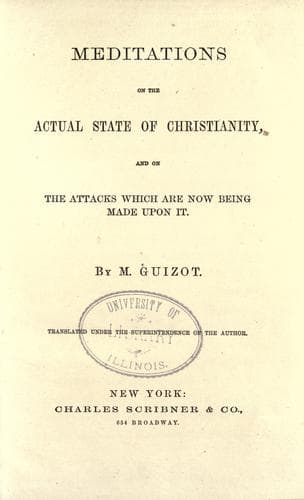
Meditations on the Actual State of Christianity, and on the Attacks Which Are Now Being Made Upon It.Guizot, François
Religion
Meditations on the Actual State of Christianity, and on the Attacks Which Are Now Being Made Upon It.
Guizot, François
Christianity; Philosophy and religion; Religious thought -- 19th century
the natural faith of mankind in the divine revelation, and in the
relations of the Creator with his creatures.
If the spiritualistic school refused from its very origin to
admit these facts, drawn from cosmogony and from man's history,
into the sphere of its labors; if it limited psychology to its
peculiar scientific object--the study of the human soul--I am far
from making such refusal matter of reproach: for the
Spiritualists did thereby nothing but what they were entitled and
called upon to do. But they have fallen into a twofold error.
While observing and describing psychological facts, they did not
perceive nor accept all that they imported: they saw in the
intelligent man the work and the trace of God; but they did not
see what was implied in that man besides--that is, revelation as
well as creation. They did not leave pure psychology to demand of
kindred sciences, such as cosmology and history, whether their
results accorded or did not accord with the results that they had
deduced from psychology.
{244}
In short, on the one side they stopped short of the limits of the
domain of psychology; and on the other, they confined themselves
to it too exclusively.
From this twofold error sprang another still more serious.
Spiritualism gave birth to Rationalism--a transformation as
unnatural as unfortunate, which has rendered the science of man
and of the intellectual world still more inexact and incomplete!
---------------------------------------
{245}
Third Meditation.
Rationalism.
A man of a mind as unprejudiced as rare, one who will never be
suspected of any undue bias for Christianity, M. Sainte-Beuve,
avowing to me recently the high esteem with which M. Alexandre
Vinet inspired him, borrowed an expression of Pascal's: "The
heart has its reasons, which the reason does not comprehend."
[Footnote 41]
[Footnote 41: Between this phrase and that of Pascal there is
a slight difference. Pascal said, "Le cœur a des raisons que
la raison ne connaît point:" "The heart has reasons that the
reason knows not at all." Pensées de Pascal, edition of M.
Faugère, 1844, vol. ii, p. 172.]
I only admit half of what is implied in this conciliatory phrase;
and these are my reasons.
{246}
True religious faith, or, to call things by their real names,
Christian faith, is founded upon instincts and upon sentiment at
the same time that it is founded upon reasons. If reason do not
accept the sentiments of the heart, on which side is the fault?
Is the fault with the heart, that it feels them, or is it with
the reason, that it does not comprehend them?
Public-domain text, read in full here on John Shaqi.
Reviews
Reviews
No reviews yet
Be the first to share your thoughts on this work.
Elsewhere in the archive
Join the Discussion
Join the discussion
Sign in to leave a comment or review.
Sign InorCreate an account