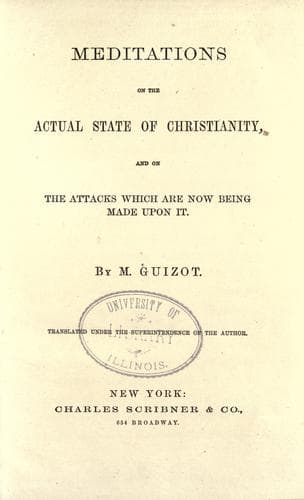
Meditations on the Actual State of Christianity, and on the Attacks Which Are Now Being Made Upon It.Guizot, François
Religion
Meditations on the Actual State of Christianity, and on the Attacks Which Are Now Being Made Upon It.
Guizot, François
Christianity; Philosophy and religion; Religious thought -- 19th century
My reply to this question is easy. I reject the distinction made.
I admit no such persons as are respectively styled the heart, the
reason. Here is only an attempt at a psychological anatomy; no
true enunciation of a real fact. Man, the human being, is
essentially one, and single: he has the faculty of
self-observation and self-study, but in exercising it he does not
destroy the unity of his nature; it is not his mere reason, it is
himself, and his whole self, that makes himself the object of his
observation and of his study, and that cannot but recognize
himself and accept himself in his entirety. He has no right to
say, with an air of scientific disdain, "My reason comprehends
not the reasons of my heart."
{247}
He must perforce say: "I comprehend not myself;" he must perforce
proclaim, not the incoherency of his being, but the insufficiency
or the incompetency of what he styles his reason.
Philosophy, like poetry, is full of personifications that
mislead; the one personifies by images, the other by
abstractions. Both have need of them--the one for its creations,
the other for its studies; I am far from seeking to deny their
respective use. All that I contend for is, that we must not
misconceive the real import of these expedients of human
language; we must not, by taking them for realities, lose sight
of or destroy what are really and genuinely realities, the
entities of divine creation.
I insist the more on this error, because in the philosophy of our
time it is a common and a potent error, and the source too of
other errors, deplorable as well in a scientific as in a moral
and practical point of view. Condillac and his disciples had set
apart and specially studied in man the faculty of sensation, and
they were thereby led to make out of this faculty, and out of it
alone, man himself and the whole man.
{248}
Kant and his school considered particularly in man the faculty of
the reason and judgment, and very soon reason came with them to
constitute the whole man. I am far from intending to examine in
its fundamental principles and its entirety the system of Kant,
the greatest philosophical work upon the human understanding that
any man has produced since the time of Plato. I single out this
fact, that it treats the reason as the proper, special, and
paramount object of philosophy. Warned by his profound,
scrupulous genius, Kant did not limit himself to a point of view
so narrow, although so lofty; he studied man's reason under its
different aspects, he constituted himself the critic of pure
reason, the critic of practical reason, the critic of æsthetic
reason--that is, of reason applied to the discrimination of the
beautiful; he decomposed, so to say, the reason itself into as
many different faculties as he found different phases in the
intellectual and moral life of man; but the faculty that he
styled the reason remained the basis of his study and of his
system.
{249}
It became in his school, and in the schools akin to it,
Public-domain text, read in full here on John Shaqi.
Reviews
Reviews
No reviews yet
Be the first to share your thoughts on this work.
Elsewhere in the archive
Join the Discussion
Join the discussion
Sign in to leave a comment or review.
Sign InorCreate an account