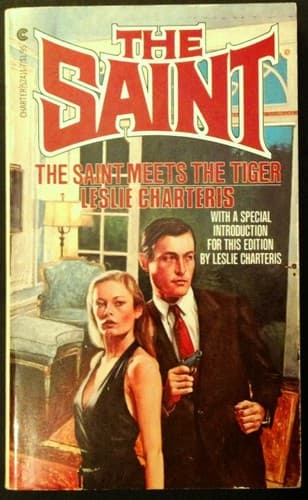
Detective and mystery stories; Private investigators -- England -- Fiction; Saint (Fictitious character) -- Fiction
Baycombe, which is really no more than a fishing village, lies barely
above sea-level, but on either side the red cliffs rise away from the
harbour, and the hills rise behind, so that Baycombe lies in a hollow
opening on the Bristol Channel. Facing seawards from the harbour, the
Pill Box would have been seen crowning the tor on the right, the only
building to the east for some ten miles; the tor on the left was some
fifty feet lower, and was dotted with half a dozen red brick and grey
stone houses belonging to the aristocracy. The Saint, _via_ Orace, who
had drunk beer in the public-house by the quay to some advantage,
already knew the names and habits of this oligarchy. The richest
member was one Hans Bloem, a Boer of about fifty, who was also reputed
to be the meanest man in Devonshire. Bloem frequently had a nephew
staying with him who was as popular as his uncle was unpopular: the
nephew was Algernon de Breton Lomas-Coper, wore a monocle, was one of
the Lads, and highly esteemed locally for a very pleasant ass. The
Best People were represented by Sir Michael Lapping, a retired Judge;
the Proletariat by Sir John Bittle, a retired Wholesale Grocer. There
was a Manor, but it had no Lord, for it had passed to a gaunt, grim,
masculine lady, Miss Agatha Girton, who lived there, unhonoured and
unloved, with her ward, whom the village honoured and loved without
exception. For the rest, there were two Indian Civil Servants who,
under the prosaic names of Smith and Shaw, survived on their pensions
in a tiny bungalow; and a Dr. Carn.
“A very dull and ordinary bunch,” reflected Simon Templar, as he stood
at the top of the village street pondering his next move. “Except,
perhaps, the ward. Is she the luvverly ’eroine of this blinkin’
adventure?”
This hopeful thought directed his steps towards the “Blue Moon,” which
was at the same time Baycombe’s club and pub. But the Saint did not
reach the “Blue Moon” that morning, because as he passed the shop
which supplied all the village requirements, from shoes to ships and
sealing-wax, a girl came out.
“I’m so sorry,” said the Saint, steadying her with one arm.
He retrieved the parcel which the collision had knocked out of her
hand, and in returning it to her he had the chance of observing her
face more closely. He could find no flaw there, and she had the most
delightful of smiles. Her head barely topped his shoulder.
“You must be the ward,” said Simon. “Miss Pat—the village doesn’t give
you a surname.”
She nodded.
“Patricia Holm,” she said. “And you must be the Mystery Man.”
“Not really—am I that already?” said the Saint with interest, and she
saw at once that the desire to hide his light under a bushel was not
one of his failings.
Public-domain text, read in full here on John Shaqi.
Reviews
Reviews
No reviews yet
Be the first to share your thoughts on this work.
Join the Discussion
Join the discussion
Sign in to leave a comment or review.
Sign InorCreate an account