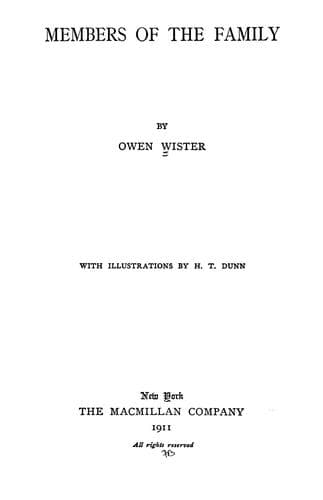
Cowboys -- Fiction; Ranch life -- Fiction; Western stories; Wyoming -- Fiction
hunting-ground of your young irresponsibility, was going to be
permanent. You must shut your eyes to see yourself and me and the
antelope as we all used to be. Why, if Adam and Eve had evaded the angel
and got back into the garden, do you think they would have found it the
same after Cain and Abel? Thus moralized the desert, and I thought, How
many things we have to shut our eyes to see!
Permanent! Living men, not very old yet, have seen the Indian on the
war-path, the buffalo stopping the train, the cow-boy driving his
cattle, the herder watching his sheep, the government irrigation dam,
and the automobile--have seen every one of these slides which progress
puts for a moment into its magic-lantern and removes to replace with a
new one. The final tale in this book could not possibly have happened in
the day of the first tale, although scarcely twenty years separate the
new, present Wyoming from that cow-boy Wyoming which then flourished so
boisterously, and is now like the antelope. Steam and electricity make
short work of epochs. We don’t know how many centuries the Indian and
the buffalo enjoyed before the trapper and pioneer arrived. These latter
had fifty or sixty good years of it, pushing westward until no west was
left to push to; a little beyond Ogden in 1869, the driving of that
golden spike which riveted the rails between New York and San Francisco,
rang out the old, rang in the new, and progress began to work its
magic-lantern faster. The soldier of the frontier, the frontier
post--gone; the cattle-range--gone; the sheep episode just come, yet
going already, or at any rate already mixed, diluted, with the farm, the
truck garden, the poultry yard, the wife, the telephone, the summer
boarder, and the Victor playing the latest Broadway “records” in valleys
where the august wilderness reigned silent--yesterday. The nomadic,
bachelor West is over, the housed, married West is established. This
rush of change, this speed we live at everywhere (only faster in some
places than in others) has led some one to remark sententiously that
when a Western baby is born, it immediately makes its will, while when a
New York baby is born, it merely applies for a divorce.
Public-domain text, read in full here on John Shaqi.
Reviews
Reviews
No reviews yet
Be the first to share your thoughts on this work.
Join the Discussion
Join the discussion
Sign in to leave a comment or review.
Sign InorCreate an account