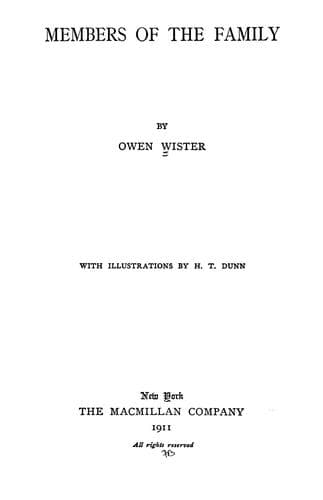
Cowboys -- Fiction; Ranch life -- Fiction; Western stories; Wyoming -- Fiction
It can happen, says Montesquieu, that the individual through pursuing
his own welfare contributes to the general good; Mr. Herbert Croly
admirably and sagaciously applies this thought to the case of the artist
and the writer. Their way to be worthy citizens and serve the State, he
says, is to see to it that their work be reverently thorough, for thus
they set high the standard of national excellence. To which I would add,
that a writer can easily take himself too seriously, but he can never
take his art too seriously. In our country, the painter and writer have
far outstripped the working-man in their ideal of honest work. This is
(partly) because painter and writer have to turn out a good product to
survive, while the working-man manages to survive with the least
possible of personal effort and skill. Did I offer my publisher such
work as the plumber and carpenter offer me, I should feel myself
disgraced. Are we to see the day when the slovenly, lazy poet shall
enact that the careful, industrious poet must work no longer and sell no
more than he?
Editors have at times lamented to me that good work isn’t distinguished
from bad by our multifarious millions. I have the happiness to know the
editors to be wrong. Let the subject of a piece of fiction contain a
simple, broad appeal, and the better its art, the greater its success;
although the noble army of readers will not suspect that their pleasure
is largely due to the skill. Such a book as _The Egoist_, where the
subject is rarefied and complex, of course no height of art will render
acceptable, save to the rehearsed few. Thanks to certain of our more
robust editors, the noble army grows daily more rehearsed, reads
“harder” books than it did, accepts plainer speech and wider range of
subject than the skittish spinster generation of a while ago. But mark
here an underlying principle. The plain speech in Richardson was in his
day nothing to start back from; to-day it is inhibited by a change in
our circumambient reticence. The circumambient reticence varies in
degree with each race, and almost with every generation of each race.
Something like a natural law, it sets the limits for what can be said
aloud in grown-up company--and Art is speaking aloud in grown-up
company; it consists no more of the professional secrets of the doctor
than it does of the prattle of the nursery. Its business is indeed to
take notice of everything in life, but always subject to the
circumambient reticence. Those gentlemen (and ladies) who utter that
gaseous shibboleth about Art for Art (as well cry Beefsteak for
Beefsteak) and would have our books and plays be foul because Ben Jonson
frequently was and Anatole France frequently is, are out of their
reckoning; and generally they may be suspected not so much of an
abstract passion for truth as of a concrete letch for animalism. Almost
the only advice for the beginner is, Clearly feel what you intend to
Public-domain text, read in full here on John Shaqi.
Reviews
Reviews
No reviews yet
Be the first to share your thoughts on this work.
Join the Discussion
Join the discussion
Sign in to leave a comment or review.
Sign InorCreate an account