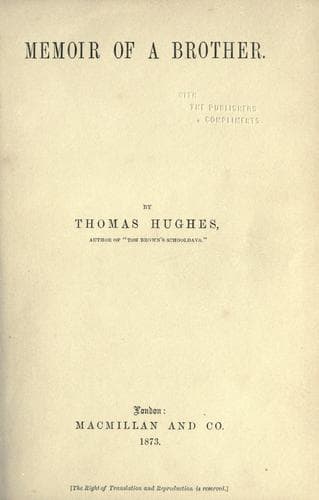
We stayed at Twyford till the end of 1833, when our father resolved to
send us to Rugby. Dr. Arnold had been a little his junior at Oriel; and,
though considerably exercised by the Doctor’s politics, he shared that
unhesitating faith in his character and ability which seems to have
inspired all his contemporaries. In the meantime George had gone up
rapidly into the highest form at Twyford, amongst boys two years older
than himself, and generally carried off not only prizes for the school
work but for all kinds of gymnastics. Twyford was a little before its
time in this respect, as we had quite a number of gymnastic poles of
different kinds in the playground, upon which we had regular lessons
under a master who came over from Winchester. Every half-year we had a
gymnastic examination, attended by the master’s daughters, and a lady or
two from the neighbourhood, who distributed the prizes (plates of fruit
and cake) at the end of the day to the successful boys. One special
occasion I well remember, in which the excitement ran particularly high.
A new prize for vaulting was to be given, not for the common style “which
any boy could do,” our master said; but for vaulting between the hands.
I don’t want any of you to try it, for it is a dangerous exercise, and
I wonder that some of us did not break our necks in attempting it. You
had to place both your hands on the back of the vaulting horse, as far
apart, or as near together, as you liked, and then spring over between
them without lifting either, even for half an inch. Of course none but
long-armed boys could do it at all; but there were enough of these for a
large entry. Very soon, however, one after another fell out, either for
touching with their feet, or shifting a hand during the vault; and George
and a very active boy, a great friend of ours in after years, Charles
Mansfield by name, were left alone. They two went on springing over the
horse, without the least touch of foot or shifting of hand, until it was
at last voted by acclamation that they should divide the great plate of
grapes, apples, and sponge cakes, which stood ready for the winner.
But I must not tell you so much of all his successes in athletic games.
These things are made too much of nowadays, until the training and
competitions for them outrun all rational bounds. What I want to show you
is, that while he was far more distinguished in these than any of you are
at all likely to be (or indeed, as things stand, than I for one should
wish you to be), he never neglected the real purpose of a schoolboy’s
life for them, as you will see from some of his early letters from Rugby
to which school we went in February 1834, when he was only twelve years
old. These are all addressed to his father and mother, and generally end,
“Please consider this for grandmama as well as for yourselves.” No boy
was ever more thoughtful of every one who had any possible claim upon
him. Here is almost the first of them.
Public-domain text, read in full here on John Shaqi.
Reviews
Reviews
No reviews yet
Be the first to share your thoughts on this work.
Join the Discussion
Join the discussion
Sign in to leave a comment or review.
Sign InorCreate an account