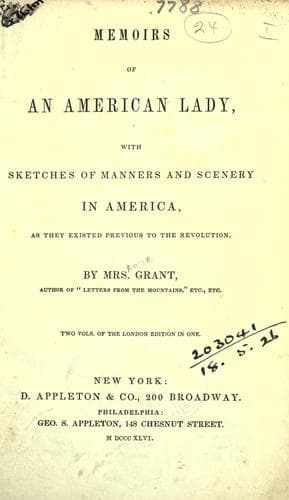
Memoirs of an American Lady: With Sketches of Manners and Scenery in America, as They Existed Previous to the Revolution — John Shaqi
Memoirs of an American Lady: With Sketches of Manners and Scenery in America, as They Existed Previous to the RevolutionGrant, Anne MacVicar
History
Memoirs of an American Lady: With Sketches of Manners and Scenery in America, as They Existed Previous to the Revolution
Grant, Anne MacVicar
Indians of North America; New York (State) -- Social life and customs -- To 1775; Schuyler, Catalina, 1701-1778 or 1779
From the time of the great rebellion, so many English refugees
frequented Holland, that the language and manners of our country became
familiar at the Hague, particularly among the Stadtholder’s party. When
the province of New-York fell under the British dominion, it became
necessary that every body should learn our language, as all public
business was carried on in the English tongue, which they did the more
willingly, as, after the revolution, the accession of the Stadholder to
the English crown very much reconciled them to our government. Still,
however, the English was a kind of court language; little spoken, and
imperfectly understood in the interior. Those who brought with them the
French and English languages soon acquired a sway over their less
enlightened fellow settlers. Of this number were the Schuylers and
Cuylers, two families among whom intellect of the superior kind seemed
an inheritance, and whose intelligence and liberality of mind, fortified
by well-grounded principle, carried them far beyond the petty and narrow
views of the rest. Habituated at home to centre all wisdom and all
happiness in commercial advantages, they would have been very ill
calculated to lay the foundation of an infant state in a country that
afforded plenty and content, as the reward of industry, but where the
very nature of the territory, as well as the state of society, precluded
great pecuniary acquisitions. Their object here was taming savage
nature, and making the boundless wild subservient to agricultural
purposes. Commercial pursuits were a distant prospect; and before they
became of consequence, rural habits had greatly changed the character of
these republicans. But the commercial spirit, inherent in all true
Batavians, only slept to wake again, when the avidity of gain was called
forth by the temptation of bartering for any lucrative commodity. The
furs of the Indians gave this occasion, and were too soon made the
object of the avidity of petty traders. To the infant settlement at
Albany the consequences of this short-sighted policy might have proved
fatal, had not these patriotic leaders, by their example and influence,
checked for a while such illiberal and dangerous practices. It is a fact
singular and worth attending to, from the lesson it exhibits, that in
all our distant colonies there is no other instance where a considerable
town and prosperous settlement has arisen and flourished, in peace and
safety, in the midst of nations disposed and often provoked to
hostility; at a distance from the protection of ships, and from the only
fortified city, which, always weakly garrisoned, was little fitted to
awe and protect the whole province. Let it be remembered that the
distance from New-York to Albany is 170 miles; and that in the
intermediate space, at the period of which I speak, there was not one
town or fortified place. The shadow of a palisadoed fort[1], which then
existed at Albany, was occupied by a single independent company, who did
Public-domain text, read in full here on John Shaqi.
Reviews
Reviews
No reviews yet
Be the first to share your thoughts on this work.
Join the Discussion
Join the discussion
Sign in to leave a comment or review.
Sign InorCreate an account