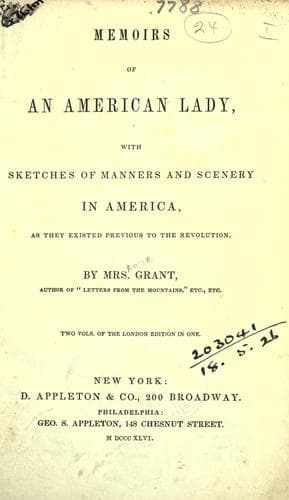
Memoirs of an American Lady: With Sketches of Manners and Scenery in America, as They Existed Previous to the RevolutionGrant, Anne MacVicar
History
Memoirs of an American Lady: With Sketches of Manners and Scenery in America, as They Existed Previous to the Revolution
Grant, Anne MacVicar
Indians of North America; New York (State) -- Social life and customs -- To 1775; Schuyler, Catalina, 1701-1778 or 1779
physical, and the use of strong liquors in a moral sense, as two plagues
which we had introduced among them, for which our arts, our friendship,
and even our religion, were a very inadequate recompense.
-------
CHAP. XXXIII.
Followers of the army—Inconveniences resulting from such.
TO return to the legion of commissaries, &c. These employments were at
first given to very inferior people; it was seen, however, that as the
scale of military operations and erections increased, these people were
enriching themselves both at the expense of the king and the
inhabitants, whom they frequently exasperated into insolence or
resistance, and then used that pretext to keep in their own hands the
payments to which these people were entitled. When their waggons and
slaves were pressed into the service, it was necessary to employ such
persons from the first. The colonel and the mayor, and all whom they
could influence, did all they could to alleviate an evil that could not
be prevented, and was daily aggravating disaffection. They found, as the
importance of these offices increased, it would conduce more to the
public good, by larger salaries to induce people to accept them who were
gentlemen, and had that character to support; and who, being acquainted
with the people and their language, knew best how to qualify and soften,
and where to apply—so as least to injure or irritate. Some young men
belonging to the country, were at length prevailed on to accept two or
three of these offices, which had the happiest effect in conciliating
and conquering the aversion that existed against the _regulars_.
Among the first of the natives who engaged in those difficult
employments, was one of aunt’s adopted sons, formerly mentioned; Philip
Schuyler, of the pasture, as he was called, to distinguish him from the
other nephew, who, had he lived, would have been the colonel’s heir. He
appeared merely a careless, good-humoured young man. Never was any one
so little what he seemed, with regard to ability, activity, and
ambition, art, enterprise, and perseverance, all of which he possessed
in an uncommon degree, though no man had less the appearance of these
qualities; easy, complying, and good-humoured, the conversations, full
of wisdom and sound policy, of which he had been a seemingly inattentive
witness at the Flats, only slept in his recollection, to awake in full
force, when called forth by occasion.
Public-domain text, read in full here on John Shaqi.
Reviews
Reviews
No reviews yet
Be the first to share your thoughts on this work.
Elsewhere in the archive
Join the Discussion
Join the discussion
Sign in to leave a comment or review.
Sign InorCreate an account