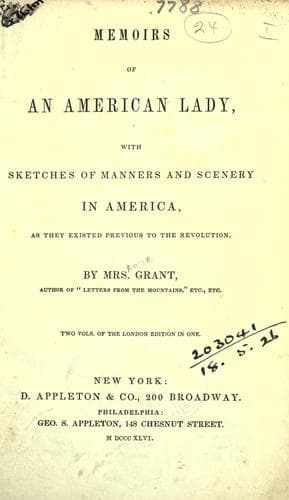
Memoirs of an American Lady: With Sketches of Manners and Scenery in America, as They Existed Previous to the RevolutionGrant, Anne MacVicar
History
Memoirs of an American Lady: With Sketches of Manners and Scenery in America, as They Existed Previous to the Revolution
Grant, Anne MacVicar
Indians of North America; New York (State) -- Social life and customs -- To 1775; Schuyler, Catalina, 1701-1778 or 1779
A shrewd and able man, who was, I think, a brigadier in the service, was
appointed quarter-master-general, with the entire superintendence of all
the boats, buildings, &c. in New-York, the Jerseys, and Canadian
frontier. He had married, when very young, a daughter of Colonel
Renssalaer. Having at the time no settled plan for the support of a
young family, he felt it incumbent on him to make some unusual exertion
for them. Colonel Schuyler and his consort, not only advised him to
accept an inferior employment in this business, but recommended him to
the Brigadier Bradstreet, who had the power of disposing of such
offices, which were daily growing in importance. They well knew that he
possessed qualities which might not only render him an useful servant to
the public, but clear his way to fortune and distinction. His perfect
command of temper, acuteness, and dispatch in business, and in the hour
of social enjoyment, easily relapsing into all that careless, frank
hilarity and indolent good-humour, which seems the peculiar privilege of
the free and disencumbered mind; active and companionable, made him a
great acquisition to any person under whom he might happen to be
employed. This the penetration of Bradstreet soon discovered; and he
became not only his secretary and deputy, but in a short time after, his
ambassador, as one might say; for before Philip Schuyler was twenty-two,
the general, as he was universally styled, sent him to England, to
negotiate some business of importance with the board of trade and
plantations. In the mean while, some other young men, natives of the
country, accepted employments in the same department, by this time
greatly extended. Averse as the country people were to the army, they
began to relish the advantage derived from the money which that body of
protectors, so much feared and detested, expended among them. This was
more considerable than might at first be imagined. Government allowed
provisions to the troops serving in America, without which they could
not indeed have proceeded through an uninhabited country; where, even in
such places as were inhabited, there were no regular markets, no
competition for supply; nothing but exorbitant prices could tempt those
people who were not poor, and found a ready market for all their produce
in the West-Indies. Now, having a regular supply of such provisions as
are furnished to the fleet, they had no occasion to lay out their money
for such things; and rather purchased the produce of the country,
liquors, &c. for which the natives took care to make them pay very high,
an evil which the Schuyler’s moderated as much as possible, though they
could not check it entirely. This provision system was a very great
though necessary evil, for it multiplied contractors, commissaries, and
store-keepers, without end. At a distance from the source of authority,
abuses increase, and redress becomes more difficult, which is, of
Public-domain text, read in full here on John Shaqi.
Reviews
Reviews
No reviews yet
Be the first to share your thoughts on this work.
Elsewhere in the archive
Join the Discussion
Join the discussion
Sign in to leave a comment or review.
Sign InorCreate an account