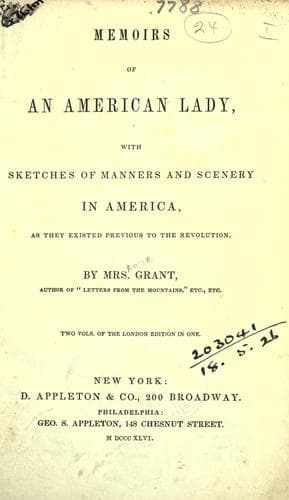
Memoirs of an American Lady: With Sketches of Manners and Scenery in America, as They Existed Previous to the RevolutionGrant, Anne MacVicar
History
Memoirs of an American Lady: With Sketches of Manners and Scenery in America, as They Existed Previous to the Revolution
Grant, Anne MacVicar
Indians of North America; New York (State) -- Social life and customs -- To 1775; Schuyler, Catalina, 1701-1778 or 1779
good man’s life, and the laborious diligence and awful earnestness with
which he inculcated the doctrines he taught, that they had produced a
correspondent effect, for the most part, on the lives of his hearers,
and led them to regard him as the next thing to an evangelist.
Accustomed to success in all his undertakings, and to “honour, love,
obedience, troops of friends,” and all that gratitude and veneration can
offer to its most distinguished object, this rebellion against his
authority, and contempt of his opinion, once the standard by which every
one’s judgment was regulated, wounded him very deeply. The abhorrence
with which he inspired the parents of the transgressors, among whom were
many young men of spirit and intelligence, was the occasion of some
family disagreements, a thing formerly scarcely known. Those young
people, accustomed to regard their parents with implicit reverence, were
unwilling to impute to them unqualified harshness, and therefore removed
the blame of a conduct so unusual to their spiritual guide; “and while
he thought, good easy man, full surely his greatness was a ripening,
nipt his root.” Early one Monday morning, after the Domine had, on the
preceding day, been peculiarly eloquent on the subject of theatrical
amusements, and pernicious innovations, some unknown person left within
his door a club, a pair of old shoes, a crust of black bread, and a
dollar. The worthy pastor was puzzled to think what this could mean, but
had it too soon explained to him. It was an emblematic message, to
signify the desire entertained of his departure. The stick was to push
him away, the shoes to wear on the road, and the bread and money a
provision for his journey. These symbols, appear, in former days, to
have been more commonly used, and better understood than at present; for
instance, we find that when Robert Bruce, afterwards king of Scotland,
was in a kind of honourable captivity in the court of England; when his
friend, the Earl of Glocester, discovered that it was the intention of
the king to imprison him in the tower, lest he should escape to Scotland
and assert his rights, unwilling by word or writing to discover what had
passed in council, and at the same time desirous to save his friend, he
sent him a pair of gilt spurs and twelve crowns, and ordered the servant
to carry them to him as returning what he had formerly borrowed from
him. This mysterious gift and message was immediately understood, and
proved the means of restoring Bruce, and, with him, the laws and liberty
of his native kingdom. Very different, however, was the effect produced
by this mal a-propos symbol of dislike. Too conscious, and too fond of
popularity, the pastor languished under a sense of imaginary
degradation, grew jealous, and thought every one alienated from him,
because a few giddy young people were stimulated, by momentary
resentments, to express disapprobation in this vague and dubious manner.
Public-domain text, read in full here on John Shaqi.
Reviews
Reviews
No reviews yet
Be the first to share your thoughts on this work.
Elsewhere in the archive
Join the Discussion
Join the discussion
Sign in to leave a comment or review.
Sign InorCreate an account