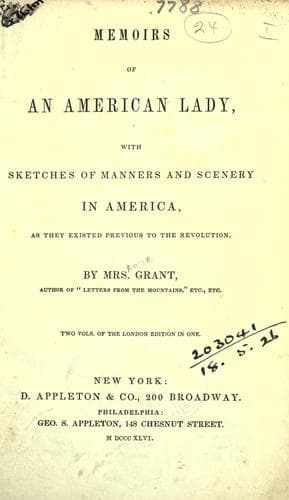
Memoirs of an American Lady: With Sketches of Manners and Scenery in America, as They Existed Previous to the RevolutionGrant, Anne MacVicar
History
Memoirs of an American Lady: With Sketches of Manners and Scenery in America, as They Existed Previous to the Revolution
Grant, Anne MacVicar
Indians of North America; New York (State) -- Social life and customs -- To 1775; Schuyler, Catalina, 1701-1778 or 1779
artless mirth so easily excited in a good-humoured child, the naivete of
its odd questions and ignorant wonder, which delight us while associated
with innocence and simplicity, would provoke the utmost disgust if we
met with them where we look for intelligence and decorous observances.
The simplicity of primitive manners, in what regards the petty
amusements and minute attentions to which we have become accustomed, is
exactly tantamount to that of childhood; it is a thing which, in our
state of society, we have no idea of. Those who are, from their
depressed situation, ignorant of the forms of polished life, know, at
least, that such exist; and either awkwardly imitate them, or carefully
avoid committing themselves, by betraying their ignorance. Here, while
this simplicity, which, by the by, was no more vulgar than that of
Shakspeare’s Miranda, with its concomitant purity, continued unbroken by
foreign modes, it had all the charm of undesigning childhood; but when
half education and ill supported pretensions took place of this sweet
attraction, it assumed a very different aspect; it was no longer
simplicity but vulgarity. There are things that every one feels and no
one can describe, and this is one of them.
But to return to our Mirandas and their theatrical heroes: the fame of
their exhibitions went abroad, and opinions were formed of them no way
favourable to the actors or to the audience. In this region of reality,
where rigid truth was always undisguised, they had not learned to
distinguish between fiction and falsehood. It was said that the
officers, familiar with every vice and every disguise, had not only
spent a whole night in telling lies in a counterfeited place, the
reality of which had never existed, but that they were themselves a lie,
and had degraded manhood, and broke through an express prohibition in
Scripture, by assuming female habits; that they had not only told lies,
but cursed and swore the whole night; and assumed the characters of
knaves, fools, and robbers, which every wise and good man held in
detestation, and no one would put on unless they felt themselves easy in
them. Painting their faces, of all other things, seemed most to violate
the Albanian ideas of decorum, and was looked upon as a most flagrant
abomination. Great and loud was the outcry produced by it. Little
skilled in sophistry, and strangers to all the arts “that make the worst
appear the better reason,” the young auditors could only say, “that
indeed it was very amusing; made them laugh heartily, and did harm to
nobody.” So harmless, indeed, and agreeable did this entertainment
appear to the new converts to fashion, that the Recruiting Officer was
given out for another night, to the great annoyance of Domine
Freylinghausen, who invoked heaven and earth to witness and avenge this
contempt, not only of his authority, but, as he expressed it, of the
source from whence it was derived. Such had been the sanctity of this
Public-domain text, read in full here on John Shaqi.
Reviews
Reviews
No reviews yet
Be the first to share your thoughts on this work.
Elsewhere in the archive
Join the Discussion
Join the discussion
Sign in to leave a comment or review.
Sign InorCreate an account