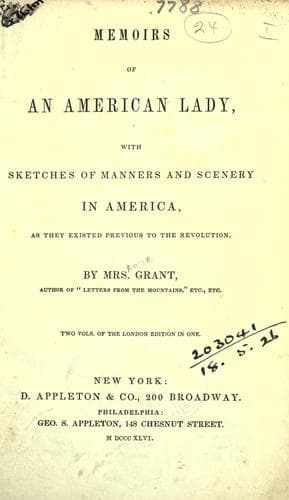
Memoirs of an American Lady: With Sketches of Manners and Scenery in America, as They Existed Previous to the RevolutionGrant, Anne MacVicar
History
Memoirs of an American Lady: With Sketches of Manners and Scenery in America, as They Existed Previous to the Revolution
Grant, Anne MacVicar
Indians of North America; New York (State) -- Social life and customs -- To 1775; Schuyler, Catalina, 1701-1778 or 1779
THE next day they heard the particulars of the skirmish, for it could
scarcely be called a regular engagement, which had proved fatal to the
young warrior, whose loss was so deeply felt. The army had crossed lake
George in safety, on the 5th of July, and landed without opposition.
They proceeded in four columns to Ticonderoga, and displayed a spectacle
unprecedented in the New World. An army of sixteen thousand men,
regulars and provincials, with a train of artillery, with all the
necessary provisions for an active campaign or regular siege, followed
by a little fleet of bateaux, pontons, &c. They set out wrong however,
by not having Indian guides, who are alone to be depended on in such a
place. In a short time the columns fell in upon each other, and
occasioned much confusion. While they marched on in this bewildered
manner, the advanced guard of the French, which had retired before them,
were equally bewildered, and falling in with them in this confusion, a
skirmish ensued, in which the French lost above three hundred men, and
we, though successful, lost as much as it was possible to lose, in one;
for here it was that Lord Howe fell.
The fort is a situation of peculiarly natural strength; it lies on a
little peninsula, with lake George on one side, and a narrow opening,
communicating with lake Champlain, on the other. It is surrounded by
water on three sides; and in front there is a swamp, very easily
defended: and where it ceased the French had made a breast-work above
eight feet high; not content with this, they had felled immense trees on
the spot, and laid them heaped on each other, with their branches
outward, before their works. In fine, there was no place on earth where
aggression was so difficult, and defence so easy, as in these woods;
especially when, as in this case, the party to be attacked had great
leisure to prepare their defence. On this impenetrable front they had
also a line of cannon mounted; while the difficulty of bringing
artillery through this swampy ground, near enough to bear upon the
place, was very great. This garrison, almost impregnable from situation,
was defended by between four and five thousand men. An engineer, sent to
reconnoitre, was of opinion that it might be attacked without waiting
for the artillery. The fatal resolution was taken without consulting
those best qualified to judge. An Indian or native American were here
better skilled in the nature of the ground, and probabilities of
success. They knew better, in short, what the spade, hatchet, or musket,
could or could not do, in such situations, than the most skilful veteran
from Europe, however replete with military science. Indeed when system
usurps the province of plain sound sense in unknown exigencies, the
result is seldom favourable; and this truth was never more fatally
demonstrated than in the course of the American war, where an obstinate
adherence to regular tactics, which do not bend to time or place,
Public-domain text, read in full here on John Shaqi.
Reviews
Reviews
No reviews yet
Be the first to share your thoughts on this work.
Elsewhere in the archive
Join the Discussion
Join the discussion
Sign in to leave a comment or review.
Sign InorCreate an account