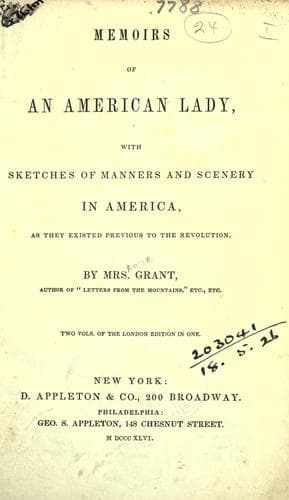
Memoirs of an American Lady: With Sketches of Manners and Scenery in America, as They Existed Previous to the RevolutionGrant, Anne MacVicar
History
Memoirs of an American Lady: With Sketches of Manners and Scenery in America, as They Existed Previous to the Revolution
Grant, Anne MacVicar
Indians of North America; New York (State) -- Social life and customs -- To 1775; Schuyler, Catalina, 1701-1778 or 1779
occasioned, from first to last, an incalculable waste of blood, of
treasure, and of personal courage. The resolution then was to attack the
enemy without loss of time, and even without waiting for artillery.
Alas! “what have not Britons dared?”
I cannot enter into the dreadful detail of what followed; certainly
never was infatuation equal to this. The forty-second regiment was then
in the height of deserved reputation; in which there was not a private
man that did not consider himself as rather above the lower class of
people, and peculiarly bound to support the honour of the very singular
corps to which he belonged. This brave hard-fated regiment was then
commanded by a veteran of great experience and military skill, Colonel
Gordon Graham, who had the first point of attack assigned to him; he was
wounded at the first onset. How many this regiment, in particular, lost
of men and officers, I cannot now exactly say; but there were very many.
What I distinctly remember, having often heard of it since, is, that, of
the survivors, every officer retired wounded off the field. Of the
fifty-fifth regiment, to which my father had newly been attached, ten
officers were killed, including all the field officers. No human beings
could show more determined courage than this brave army did. Standing
four hours under a constant discharge of cannon and musketry from
barricades, on which it was impossible for them to make the least
impression, General Abercrombie saw the fruitless waste of blood that
was every hour increasing, and ordered a retreat, which was very
precipitate, so much so, that they crossed the lake, and regained their
camp on the other side, the same night. Two thousand men were killed,
wounded, or taken, on this disastrous day. On the next, those most
dangerously wounded were sent forward in boats, and reached the Flats
before evening; they in a manner brought (at least confirmed) the news
of the defeat. Madame had her barn instantly fitted up into a temporary
hospital, and a room in her house allotted for the surgeon who attended
the patients: among these was Lee, the same insolent and rapacious Lee,
who had insulted this general benefactress, and deprived her of one of
her greatest pleasures, that of giving a share of every thing she had to
advance the service. She treated him with compassion, without adverting,
by the least hint, to the past. She tore up her sheets and table linen
for bandages; and she and her nieces were constantly employed in
attending and cheering the wounded, while all her domestics were busied
in preparing food and every thing necessary for those unhappy sufferers.
Even Lee felt and acknowledged the resistless force of such generous
humanity. He swore, in his vehement manner, that he was sure there would
be a place reserved for madame in heaven, though no other woman should
be there, and that he should wish for nothing better than to share her
final destiny. The active, industrious beneficence she exercised at this
Public-domain text, read in full here on John Shaqi.
Reviews
Reviews
No reviews yet
Be the first to share your thoughts on this work.
Elsewhere in the archive
Join the Discussion
Join the discussion
Sign in to leave a comment or review.
Sign InorCreate an account