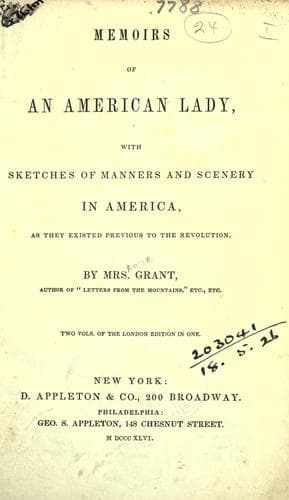
Memoirs of an American Lady: With Sketches of Manners and Scenery in America, as They Existed Previous to the Revolution — John Shaqi
Memoirs of an American Lady: With Sketches of Manners and Scenery in America, as They Existed Previous to the RevolutionGrant, Anne MacVicar
History
Memoirs of an American Lady: With Sketches of Manners and Scenery in America, as They Existed Previous to the Revolution
Grant, Anne MacVicar
Indians of North America; New York (State) -- Social life and customs -- To 1775; Schuyler, Catalina, 1701-1778 or 1779
But to return to our Sachems, from whom we have too long digressed; when
they arrived at Albany, they did not, as might be expected, hasten home
to communicate their discoveries, or display their acquisitions. They
summoned a congress there, not only of the elders of their own nation,
but the chiefs of all those with whom they were in alliance. This solemn
meeting was held in the Dutch church. In the present depressed and
diminished state of these once powerful tribes, so few traces of their
wonted energy remain, that it could scarce be credited, were I able to
relate with what bold and flowing eloquence they clothed their
conceptions; powerful reasoning, emphatic language, and graceful action,
added force to their arguments; while they persuaded their adherents to
renounce all connexion with the tribes under the French influence; and
form a lasting league, offensive and defensive, with that great queen,
whose mild majesty had so deeply impressed them; and the mighty people
whose kindness had gratified, and whose power had astonished them, whose
populous cities swarmed with arts and commerce, and in whose floating
castles they had rode safely over the ocean. I have seen a volume of the
speeches of these Mohawks preserved by Colonel Schuyler; they were
literally translated, so that the native idiom was preserved; which,
instead of appearing uncouth, seemed to add to their strength and
sublimity.
When Mr. Schuyler returned from England, about the year 1709, his niece
Catalina, the subject of this narrative, was about seven years old; he
had a daughter and sons, yet this child was early distinguished above
the rest for docility, a great desire of knowledge, and an even and
pleasing temper; this her uncle early observed. It was at that time very
difficult to procure the means of instruction in those inland districts;
female education of consequence was conducted on a very limited scale;
girls learnt needle-work (in which they were indeed both skilful and
ingenious) from their mothers and aunts; they were taught too at that
period to read, in Dutch, the Bible and a few Calvinistic tracts of the
devotional kind. But in the infancy of the settlement few girls read
English; when they did, they were thought accomplished; they generally
spoke it, however imperfectly, and few were taught writing. This
confined education precluded elegance; yet, though there was no polish,
there was no vulgarity. The dregs of the people, who subside to the
bottom of the mass, are not only degraded by abject poverty, but so
utterly shut out from intercourse with the more enlightened, and so
rankling with envy at feeling themselves so, that a sense of their
condition gradually debases their minds; and this degradation
communicates to their manners, the vulgarity of which we complain. This
more particularly applies to the lower class in towns; for mere
simplicity, or even a rustic bluntness, I would by no means call
vulgarity.
Public-domain text, read in full here on John Shaqi.
Reviews
Reviews
No reviews yet
Be the first to share your thoughts on this work.
Join the Discussion
Join the discussion
Sign in to leave a comment or review.
Sign InorCreate an account