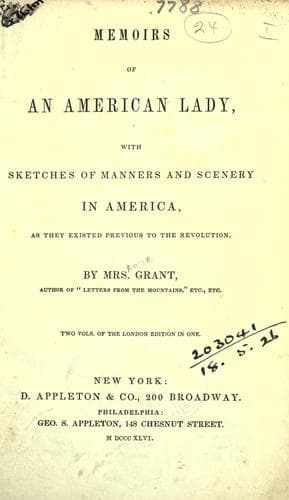
Memoirs of an American Lady: With Sketches of Manners and Scenery in America, as They Existed Previous to the RevolutionGrant, Anne MacVicar
History
Memoirs of an American Lady: With Sketches of Manners and Scenery in America, as They Existed Previous to the Revolution
Grant, Anne MacVicar
Indians of North America; New York (State) -- Social life and customs -- To 1775; Schuyler, Catalina, 1701-1778 or 1779
My father, not being satisfied with the single apartment allotted to him
by the new comers, removed to the town; where a friend of his, a Scotch
merchant, gave him a lodging in his own house, next to that very Madame
Schuyler who had been so long my daily thoughts and nightly dreams. We
had not been long there when aunt heard that my father was a good,
plain, upright man, without pretensions, but very well principled. She
sent a married lady, the wife of her favourite nephew, who resided with
her at the time, to ask us to spend the evening with her. I think I have
not been on any occasion more astonished, than when, with no little awe
and agitation, I came into the presence of madame. She was sitting; and
filled a great chair, from which she seldom moved. Her aspect was
composed, and her manner, such as was at first more calculated to
inspire respect, than conciliate affection. Not having the smallest
solicitude about what people thought of her, and having her mind
generally occupied with matters of weighty concern, the first expression
of her kindness seemed rather a lofty courtesy, than attractive
affability: but she shone out by degrees; and she was sure eventually to
please every one worth pleasing, her conversation was so rich, so
varied, so informing; every thing she said bore such a stamp of reality:
her character had such a grasp in it. Her expressions, not from art and
study, but from the clear perceptions of her sound and strong mind, were
powerful, distinct, and exactly adapted to the occasion. You saw her
thoughts as they occurred to her mind, without the usual bias rising
from either a fear to offend, or a wish to please. This was one of the
secrets in which lay the singular power of her conversation. When
ordinary people speak to you, your mind wanders in search of the motives
that prompt their discourse, or the views and prejudices which bias it;
when those who excite (and perhaps solicit) admiration talk, you are
secretly asking yourself whether they mean to inform, or dazzle you. All
this interior canvass vanished before the evident truth and unstudied
ease of aunt’s discourse. On a nearer knowledge, too, you found she was
much more intent to serve, than please you, and too much engrossed by
her endeavours to do so, to stop and look round for your gratitude,
which she heeded just as little as your admiration. In short, she
informed, enlightened, and served you, without levying on you any
tribute whatever, except the information you could give in return. I
describe her appearance as it then struck me; and, once for all, her
manners and conversation, as I thought of them when I was older and knew
better how to distinguish and appreciate. Every thing about her was
calculated to increase the impression of respect and admiration; which,
from the earliest dawn of reflection, I had been taught to entertain for
her. Her house was the most spacious and best furnished I had ever
entered.
Public-domain text, read in full here on John Shaqi.
Reviews
Reviews
No reviews yet
Be the first to share your thoughts on this work.
Elsewhere in the archive
Join the Discussion
Join the discussion
Sign in to leave a comment or review.
Sign InorCreate an account