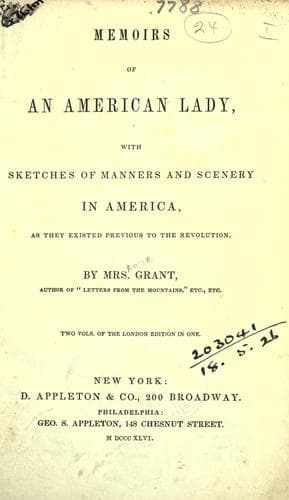
Memoirs of an American Lady: With Sketches of Manners and Scenery in America, as They Existed Previous to the RevolutionGrant, Anne MacVicar
History
Memoirs of an American Lady: With Sketches of Manners and Scenery in America, as They Existed Previous to the Revolution
Grant, Anne MacVicar
Indians of North America; New York (State) -- Social life and customs -- To 1775; Schuyler, Catalina, 1701-1778 or 1779
The family pictures, and scripture paintings, were to me
particularly awful and impressive. I compared them to the models which
had before existed in my imagination, and was delighted or mortified, as
I found they did or did not resemble them.
The family with which she was then surrounded, awakened a more than
common interest. Her favourite nephew, the eldest son of her much
beloved sister, had, by his father’s desire, entered into partnership in
a great commercial house in New-York. Smitten with the uncommon beauty
of a young lady of seventeen, from Rhode-Island, he had married her
without waiting for the consent of his relations. Had he lived in
Albany, and connected himself with one of his fellow citizens, bred up
in frugal simplicity, this step might have been easily got over. But an
expensive and elegant style of living begun already to take place in
New-York; which was, from the residence of the governor and commander in
chief, become the seat of a little court. The lady, whom Philip had
married, was of a family originally Scotch; and derived her descent at
no great distance from one of the noblest families in that country.[20]
Gay, witty, and very engaging, beloved and indulged, beyond measure, by
a fond husband, who was generous and good natured to excess, this young
beauty became “the glass of fashion, and the mould of form.” And the
house of this amiable couple was the resort of all that was gay and
elegant, and the centre of attraction to strangers. The mayor, who was a
person singularly judicious, and most impartial in the affection which
he distributed amongst his large family, saw clearly that the young
people trusted too much to the wealth he was known to possess, and had
got into a very expensive style of living; which, on examining their
affairs, he did not think likely to be long supported by the profits of
the business in which his son was engaged. The probable consequence of a
failure, he saw, would so far involve him as to injure his own family:
this he prevented. Peace was daily expected; and the very existence of
the business in which he was engaged, depended on the army; which his
house was wont to furnish with every thing necessary. He clearly foresaw
the withdrawing of this army; and that the habits of open hospitality
and expensive living would remain, when the sources of their present
supplies were dried up. He insisted on his son entirely quitting this
line, and retiring to Albany. He loaded a ship on his own account for
the West-Indies, and sent the young man as supercargo, to dispose of the
lading. As house-keeping was given up in New-York, and not yet resumed
in Albany, this young creature had only the option of returning to the
large family she had left, or going to her father-in-law’s. Aunt
Schuyler, ever generous and considerate, had every allowance to make for
the high spirit and fine feelings of this inexperienced young creature;
and invited her, with her little daughter, to remain with her till her
Public-domain text, read in full here on John Shaqi.
Reviews
Reviews
No reviews yet
Be the first to share your thoughts on this work.
Elsewhere in the archive
Join the Discussion
Join the discussion
Sign in to leave a comment or review.
Sign InorCreate an account