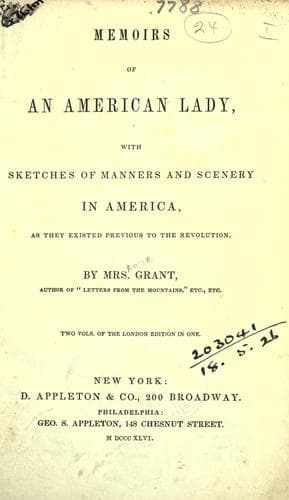
Memoirs of an American Lady: With Sketches of Manners and Scenery in America, as They Existed Previous to the RevolutionGrant, Anne MacVicar
History
Memoirs of an American Lady: With Sketches of Manners and Scenery in America, as They Existed Previous to the Revolution
Grant, Anne MacVicar
Indians of North America; New York (State) -- Social life and customs -- To 1775; Schuyler, Catalina, 1701-1778 or 1779
Major Duncan’s comprehensive mind took in every thing that had any
tendency to advance the general good, and cement old alliances. He saw
none of the Hurons, whose territories lay far above Ontario, but those
tribes whose course of hunting or fishing led them to his boundaries,
were always kindly treated. He often made them presents of ammunition or
provision, and did every thing in his power to conciliate them. Upon
hearing of the outrage which the Hurons[21] had been guilty of, the
heads of the tribe, with whom the major had cultivated the greatest
intimacy, came to assure him of their good wishes, and hearty
co-operation. He invited them to come with their tribe to celebrate the
birth-day of their new king (his present majesty) which occurred a few
days after, and there solemnly renew, with the usual ceremonies, the
league offensive and defensive made between their fathers and the late
king. They came accordingly in their best arms and dresses, and assisted
at a review, and at a kind of feast given on the occasion, on the
outside of the fort. The chief and his brother, who were two fine noble
looking men, were invited to dine with the major and officers. When they
arrived, and were seated, the major called for a glass of wine to drink
his sovereign’s health; this was no sooner done, than the sachem’s
brother fell lifeless on the floor. They thought it was a fainting fit,
and made use of the usual applications to recover him, which, to their
extreme surprise, proved ineffectual. His brother looked steadily on
while all those means were using; but when convinced of their
inefficacy, sat down, drew his mantle over his face, sobbed aloud, and
burst into tears. This was an additional wonder. Through the traces of
Indian recollection no person had been known to fall suddenly dead
without any visible cause, nor any warrior to shed tears. After a pause
of deep silence, which no one felt inclined to break, the sachem rose
with a collected and dignified air, and thus addressed the witnesses of
this affecting incident: “Generous English, misjudge me not; though you
have seen me for once a child, in the day of battle you will see a man,
who will make the Hurons weep blood. I was never thus before. But to me
my brother was all. Had he died in battle, no look of mine would change.
His nation would honour him, but his foes should lament him. I see
sorrow in your countenances; and I know you were not the cause of my
brother’s death. Why, indeed, should you take away a life that was
devoted to you? Generous English, ye mourn for my brother, and I will
fight your battles.” This assurance of his confidence was very necessary
to quiet the minds of his friends; and the concern of the officers was
much aggravated by the suspicious circumstances attending his death so
immediately after the drinking of the wine they had given him. The major
ordered this lamented warrior to be interred with great ceremony. A
Public-domain text, read in full here on John Shaqi.
Reviews
Reviews
No reviews yet
Be the first to share your thoughts on this work.
Elsewhere in the archive
Join the Discussion
Join the discussion
Sign in to leave a comment or review.
Sign InorCreate an account