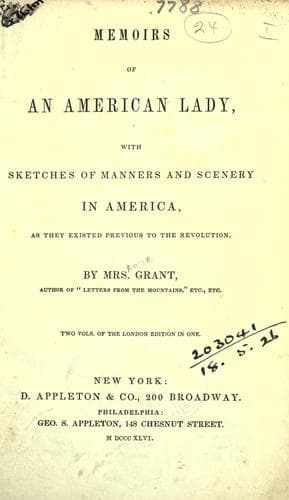
Memoirs of an American Lady: With Sketches of Manners and Scenery in America, as They Existed Previous to the RevolutionGrant, Anne MacVicar
History
Memoirs of an American Lady: With Sketches of Manners and Scenery in America, as They Existed Previous to the Revolution
Grant, Anne MacVicar
Indians of North America; New York (State) -- Social life and customs -- To 1775; Schuyler, Catalina, 1701-1778 or 1779
solemn procession, mournful music, the firing of cannon, and all other
military honours, evinced his sympathy for the living, and his respect
for the dead; and the result of this sad event, in the end, rather
tended to strengthen the attachment of those Indians to the British
cause.
Footnote 21:
The author, perhaps, uses the term Huron, where that of Algonquin
would have been more correct. She does not recollect the distinctive
terms exactly, but applies the epithet, in general, to the Indians who
then occupied the banks of the Huron Lake, and the adjacent country.
I have given this singular occurrence a place in these memoirs, as it
serves to illustrate the calm good sense and steady confidence which
made a part of the Indian character, and added value to their
friendship, when once it was fairly attained.
The fifty-fifth, which had been under orders to return home, felt a
severe disappointment in being, for two years more, confined to their
sylvan fortresses. These, however, they embellished, and rendered
comfortable, with gardens and farm grounds, that, to reside in them,
could no longer be accounted a penance. Yet, during the Indian war, they
were, from motives of necessary caution, confined to very narrow limits;
which, to those accustomed to pursue their sports with all that wild
liberty and wide excursion peculiar to savage hunters, was a hardship of
which we can have no idea. Restrained from this unbounded license,
fishing became their next favourite pursuit, to which the lakes and
rivers on which these forts were built, afforded great facility. Tempted
by the abundance and excellence of the productions of these copious
waters, they were led to endanger their health by their assiduity in
this amusement. Agues, the disease of all new establishments, became
frequent among them, and were aggravated by the home sickness. To this
they were more peculiarly liable, as the regiment, just newly raised
before they embarked for America, had quitted the bosom of their
families, without passing through the gradation of boarding-schools and
academies, as is usual in other countries.
Public-domain text, read in full here on John Shaqi.
Reviews
Reviews
No reviews yet
Be the first to share your thoughts on this work.
Elsewhere in the archive
Join the Discussion
Join the discussion
Sign in to leave a comment or review.
Sign InorCreate an account