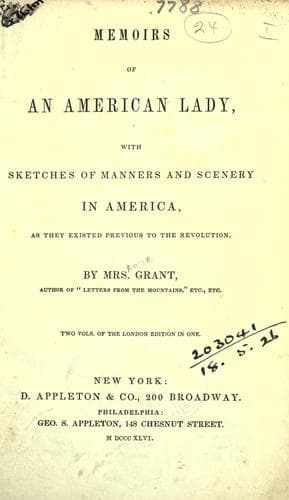
Memoirs of an American Lady: With Sketches of Manners and Scenery in America, as They Existed Previous to the RevolutionGrant, Anne MacVicar
History
Memoirs of an American Lady: With Sketches of Manners and Scenery in America, as They Existed Previous to the Revolution
Grant, Anne MacVicar
Indians of North America; New York (State) -- Social life and customs -- To 1775; Schuyler, Catalina, 1701-1778 or 1779
considerate liberality and useful sympathy more fully exerted than on
this occasion, which brought so many poor travellers from their distant
homes on this pilgrimage to the shrine of nature. How many traders did
she persuade to take them gratis in their boats! How many did she feed
and lodge! and in what various ways did she serve or make others serve
them all. No one, indeed, knew how to refuse a request of aunt Schuyler,
who never made one for herself.
-------
CHAP. LIII.
Return of the fifty-fifth regiment to Europe—Privates sent to Pensacola.
THE fifty-fifth now left their calm abodes amidst their lakes and
forests, with the joy of children breaking up from their school; little
aware that they were bidding adieu to quiet, plenty, and freedom, and
utter strangers to the world into which they were about to plunge. They
all came down to Albany. Captain Mungo Campbell was charmed to find me
so familiar with his Milton; while I was equally charmed to find him a
favourite with aunt Schuyler, which was with me the criterion of merit.
Colonel Duncan, for such he was now, marched proudly at the head of his
pupils, whom he had carried up raw youths, but brought back with all the
manly and soldierly openness of manner and character that could be
wished, and with minds greatly improved. Meanwhile, madame’s counsels
had so much influence on my father, that he began seriously to think of
settling in America. To part with his beloved fifty-fifth was very
trying; yet his prospects of advantage in remaining among a people by
whom he was esteemed, and to whom he had really become attached, were
very flattering; for by the aid of aunt and the old inhabitants, and
friendly Indians, who were at her powerful bidding, he could expect to
get advantageously some lands which he, in common with other officers
who served in America, was entitled to. He having a right to apply for
the allotted quantity wherever he found it vacant, that is, in odd
unoccupied places, between different patents, which it required much
local knowledge of the country to discover, had greatly the advantage of
strangers; because he could get information of those secluded spots here
and there, that were truly valuable; whereas other officers belonging to
regiments disbanded in the country, either did not find it convenient to
go to the expense of taking out a patent, and surveying the lands, and
so sold their rights for a trifle to others; or else half a dozen went
together, and made a choice, generally an injudicious one, of some large
tract of ground, which would not have been so long unsolicited had it
been of real value. My father bought the rights of two young officers
who were in a hurry to go to Europe, and had not, perhaps, wherewithal
to go through the necessary forms used to appropriate a particular spot,
the expense of that process being considerable. Accordingly, he became a
Public-domain text, read in full here on John Shaqi.
Reviews
Reviews
No reviews yet
Be the first to share your thoughts on this work.
Elsewhere in the archive
Join the Discussion
Join the discussion
Sign in to leave a comment or review.
Sign InorCreate an account