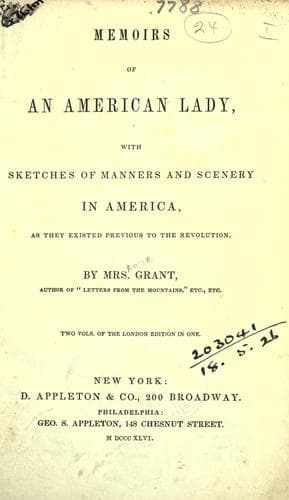
Memoirs of an American Lady: With Sketches of Manners and Scenery in America, as They Existed Previous to the RevolutionGrant, Anne MacVicar
History
Memoirs of an American Lady: With Sketches of Manners and Scenery in America, as They Existed Previous to the Revolution
Grant, Anne MacVicar
Indians of North America; New York (State) -- Social life and customs -- To 1775; Schuyler, Catalina, 1701-1778 or 1779
consequential landholder, and had half his pay to boot.
The fifty-fifth were now preparing to embark for that home which they
regarded with enthusiasm; this extended to the lowest ranks, who were
absolutely home-sick. They had, too, from the highest to the lowest,
been enabled, from their unexpensive mode of living, to lay up some
money. Never was there a body of men more uncorrupted and more attached
to each other. Military men contract a love of variety in their
wandering manner of life, and always imagine they are to find some
enjoyment in the next quarters that they have not had in this; so that
the order for march is generally a joyful summons to the younger
officers at least. To these novices, who, when they thought the world of
variety, glory, and preferment was open before them, were ordered up
into the depth of unexplored forests, to be kept stationary for years
together, without even the amusement of a battle, it was sufficiently
disappointing. Yet afterwards I have been told that, in all the changes
to which this hapless regiment was subjected, they looked back on the
years spent on the lakes as the happiest of their lives.
My father parted with them with extreme regret, but he had passed the
rubicon—that is to say, taken out his patent, and stay he must. He went,
however, to New-York with them, and here a very unexpected scene opened.
Many of the soldiers who had saved little sums, had deposited them in my
father’s hands, and, when he gave every one his own at New-York, he had
great pleasure in seeing their exultation, and the purchases they were
making. When, all of a sudden, a thunderbolt burst among these poor
fellows, in the shape of an order to draft the greatest part of them to
Pensacola, to renew regiments who, placed on a bar of burning sand, with
a salt marsh before and a swamp behind, were lingering out a wretched
and precarious existence, daily cut short by disease in some new
instance. Words are very inadequate to give an idea of the horror that
pervaded this band of veterans. When this order was most unexpectedly
read at the head of the regiment, it was worse to most of them than a
sentence of immediate death. They were going to a dismal and detested
quarter, and they were going to become part of a regiment of no repute;
whom they themselves had held in the utmost contempt when they had
formerly served together. The officers were not a little affected by
this cruel order; to part with brave well-disciplined men, who, by their
singular good conduct, and by the habits of sharing with their officers
in the chase, and in their agricultural amusements, fishing parties, &c.
had acquired a kindly nearness to them, not usually subsisting between
those who command and they who must implicitly obey. What ties were
broken! what hopes were blasted by this fatal order! These sad exiles
embarked for Pensacola at the same time that their comrades set out for
Ireland. My father returned, sunk in the deepest sadness, which was
Public-domain text, read in full here on John Shaqi.
Reviews
Reviews
No reviews yet
Be the first to share your thoughts on this work.
Elsewhere in the archive
Join the Discussion
Join the discussion
Sign in to leave a comment or review.
Sign InorCreate an account