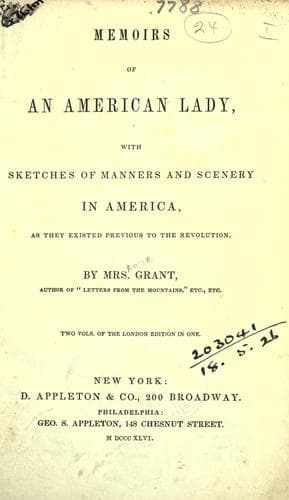
Memoirs of an American Lady: With Sketches of Manners and Scenery in America, as They Existed Previous to the RevolutionGrant, Anne MacVicar
History
Memoirs of an American Lady: With Sketches of Manners and Scenery in America, as They Existed Previous to the Revolution
Grant, Anne MacVicar
Indians of North America; New York (State) -- Social life and customs -- To 1775; Schuyler, Catalina, 1701-1778 or 1779
The only thing that disturbed me, was aunt Schuyler’s age, and the
thoughts of outliving her, which sometimes obtruded among my day dreams
of more than mortal happiness. I thought all this could scarce admit of
addition; yet a new source of joy was opened, when I found that we were
actually going to live at the Flats. That spot, rendered sacred by the
residence of aunt, where I should trace her steps wherever I moved,
dwell under the shadow of her trees, and, in short, find her in every
thing I saw. We did not aspire to serious farming, reserving that effort
for our own estate, of which we talked very magnificently, and indeed
had some reason, it being as valuable as so much land could be: and from
its situation in a part of the country which was hourly acquiring fresh
inhabitants, its value daily increased, which consideration induced my
father to refuse several offers for it; resolved either to people it
with Highland emigrants, or retain it in his own hands till he should
get his price.
Sir Henry Moore, the last British governor of New-York that I remember,
came up this summer to see Albany, and the ornament of Albany—aunt
Schuyler; he brought Lady Moore and his daughter with him. They resided
for some time at General Schuyler’s, I call him so by anticipation; for
sure I am, had any gifted seer foretold then what was to happen, he
would have been ready to answer, “Is thy servant a dog, that he should
do this thing?” Sir Harry, like many of his predecessors, was a mere
show governor, and old Cadwallader Colden, the lieutenant governor,
continued to do the business, and enjoy the power in its most essential
branches, such as giving patents for lands, &c. Sir Harry, in the
meantime, had never thought of business in his life: he was honourable,
as far as a man could be so, who always spent more than he had; he was,
however, gay, good natured, and well bred, affable and courteous in a
very high degree, and if the business of a governor was merely to keep
the governed in good humour, no one was fitter for that office than he,
the more so, as he had sense enough to know two things of great
importance to be known: one was, that a person of tried wisdom and good
experience like Colden, was fitter to transact the business of the
province, than any dependent of his own; the other, that he was totally
unfit to manage it himself. The government house was the scene of
frequent festivities and weekly concerts, Sir Henry being very musical,
and Lady Moore peculiarly fitted for doing the honours of a drawing-room
or entertainment. They were too fashionable, and too much hurried to
find time for particular friendships, and too good natured and well bred
to make invidious distinctions, so that, without gaining very much
either of esteem or affection, they pleased every one in the circle
around them; and this general civility of theirs, in the storm which was
about to arise, had its use. In the beginning, before the tempest broke
Public-domain text, read in full here on John Shaqi.
Reviews
Reviews
No reviews yet
Be the first to share your thoughts on this work.
Elsewhere in the archive
Join the Discussion
Join the discussion
Sign in to leave a comment or review.
Sign InorCreate an account