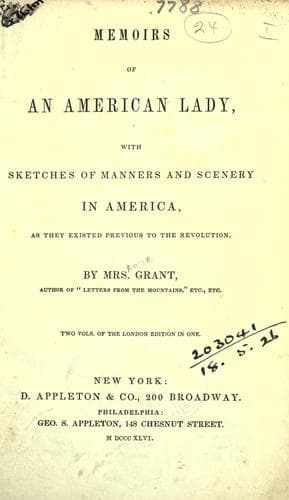
Memoirs of an American Lady: With Sketches of Manners and Scenery in America, as They Existed Previous to the RevolutionGrant, Anne MacVicar
History
Memoirs of an American Lady: With Sketches of Manners and Scenery in America, as They Existed Previous to the Revolution
Grant, Anne MacVicar
Indians of North America; New York (State) -- Social life and customs -- To 1775; Schuyler, Catalina, 1701-1778 or 1779
loose in all its fury, it was like oil poured on agitated waters, which
produces a temporary calm immediately round the ship. As yet the storm
only muttered at a distance, but madame was disturbed by anxious
presages. In her case,
“Old experience actually did attain
To something like prophetic strain.”
But it was not new to her to prophecy in vain. I, for my part, was
charmed with the manners of these exalted visitors of aunt’s, and not a
little proud of their attention to her, not knowing that they showed
pretty much the same attention to every one.
While I was dancing on air with the thoughts of going to live at the
Flats, of the beauties of Clarendon, and many other delights which I had
created to myself, an event took place that plunged us all in sorrow; it
was the death of the lovely child Catalina, who was the object of much
fondness to us all, for my parents, bating the allowance to be made for
enthusiasm, were as fond of her as I was. Madame had set her heart very
much on this engaging creature; she mustered up all her fortitude to
support the parents of her departed favourite, but suffered much
notwithstanding. Here began my acquaintance with sorrow. We went,
however, to the Flats in autumn. Our family consisted of a negro girl,
and a soldier, who had followed my father’s fortunes from Scotland, and
stuck to him through every change. We did not mean to farm, but had
merely the garden, orchard, and enclosure for hay, two cows, a horse for
my father, and a colt, which, to my great delight, was given me as a
present. Many sources of comfort and amusement were now cut off from
madame; her nephew and his lively and accomplished wife had left her;
Dr. Ogilvie was removed to New-York, and had a successor no way
calculated to supply his place. This year she had lost her
brother-in-law Cornelius Cuyler,[23] whose sound sense and intelligence
made his society of consequence to her, independent of the great esteem
and affection she had for him. The army, among whom she always found
persons of information and good breeding, in whose conversation she
could take pleasure which might be truly called such, were gone. Nothing
could compensate, in her opinion, for the privation of that enjoyment;
she read, but then the people about her had so little taste for reading,
that she had not her wonted pleasure in that, for want of some one with
whom she could discuss the topics suggested by her studies. It was in
this poverty of society, such as she was accustomed to enjoy, that she
took a fancy to converse much with me, to regret my want of education,
and to take a particular interest in my employments and mental
improvement. That I might more entirely profit by her attention, she
requested my parents to let me pass the winter with her: this invitation
they gladly complied with.
Footnote 23:
Public-domain text, read in full here on John Shaqi.
Reviews
Reviews
No reviews yet
Be the first to share your thoughts on this work.
Elsewhere in the archive
Join the Discussion
Join the discussion
Sign in to leave a comment or review.
Sign InorCreate an account