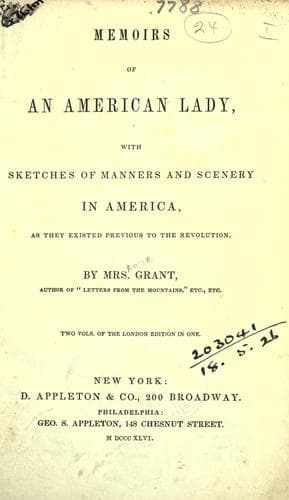
Memoirs of an American Lady: With Sketches of Manners and Scenery in America, as They Existed Previous to the RevolutionGrant, Anne MacVicar
History
Memoirs of an American Lady: With Sketches of Manners and Scenery in America, as They Existed Previous to the Revolution
Grant, Anne MacVicar
Indians of North America; New York (State) -- Social life and customs -- To 1775; Schuyler, Catalina, 1701-1778 or 1779
THE city of Albany was stretched along the banks of the Hudson; one very
wide and long street lay parallel to the river, the intermediate space
between it and the shore being occupied by gardens. A small, but steep
hill rose above the centre of the town, on which stood a fort, intended
(but very ill adapted) for the defence of the place, and of the
neighbouring country. From the foot of this hill, another street was
built, sloping pretty rapidly down till it joined the one before
mentioned that ran along the river. This street was still wider than the
other; it was only paved on each side, the middle being occupied by
public edifices. These consisted of a market-place, or guard-house, a
town hall, and the English and Dutch churches. The English church,
belonging to the Episcopal persuasion, and in the diocese of the bishop
of London, stood at the foot of the hill, at the upper end of the
street. The Dutch church was situated at the bottom of the descent where
the street terminated; two irregular streets, not so broad, but equally
long, ran parallel to those, and a few even ones open between them. The
town, in proportion to its population, occupied a great space of ground.
This city, in short, was a kind of semi-rural establishment; every house
had its garden, well, and a little green behind; before every door a
tree was planted, rendered interesting by being coeval with some beloved
member of the family; many of their trees were of a prodigious size and
extraordinary beauty, but without regularity, every one planting the
kind that best pleased him, or which he thought would afford the most
agreeable shade to the open portico at his door, which was surrounded by
seats, and ascended by a few steps. It was in these that each domestic
group was seated in summer evenings to enjoy the balmy twilight, or
serenely clear moonlight. Each family had a cow, fed in a common pasture
at the end of the town. In the evening they returned all together, of
their own accord, with their tinkling bells hung at their necks, along
the wide and grassy street, to their wonted sheltering trees, to be
milked at their master’s doors. Nothing could be more pleasing to a
simple and benevolent mind than to see thus, at one view, all the
inhabitants of a town, which contained not one very rich or very poor,
very knowing or very ignorant, very rude or very polished individual; to
see all these children of nature enjoying in easy indolence, or social
intercourse,
“The cool, the fragrant, and the _dusky_ hour,”
Public-domain text, read in full here on John Shaqi.
Reviews
Reviews
No reviews yet
Be the first to share your thoughts on this work.
Join the Discussion
Join the discussion
Sign in to leave a comment or review.
Sign InorCreate an account