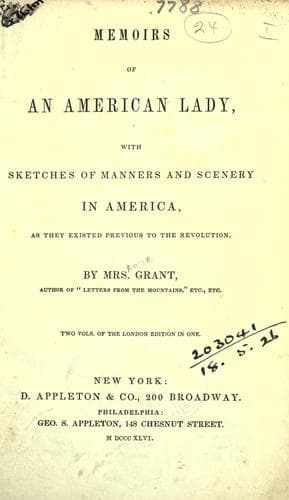
Memoirs of an American Lady: With Sketches of Manners and Scenery in America, as They Existed Previous to the RevolutionGrant, Anne MacVicar
History
Memoirs of an American Lady: With Sketches of Manners and Scenery in America, as They Existed Previous to the Revolution
Grant, Anne MacVicar
Indians of North America; New York (State) -- Social life and customs -- To 1775; Schuyler, Catalina, 1701-1778 or 1779
affluence, purchased with the blood and tears of their friends and
countrymen, the hard task remains to them of chaining up and reducing to
submission the many-headed monster, whom they have been forced to let
loose and gorge with the spoils of the vanquished. Then, too, comes on
the difficulty of dividing power where no one has a right, and every one
a claim: of ruling those whom they have taught to despise authority; and
of reviving that sentiment of patriotism, and that love of glory, which
faction and self-interest have extinguished.
When the white and red roses were the symbols of faction in England, and
when the contest between Baliol and Bruce made way for invasion and
tyranny in Scotland, the destruction of armies and of cities, public
executions, plunder and confiscations, were the least evils that they
occasioned. The annihilation of public virtue and private confidence;
the exasperation of hereditary hatred; the corrupting the milk of human
kindness, and breaking asunder every sacred tie by which man and man are
held together: all these dreadful results of civil discord are the means
of visiting the sins of civil war on the third and fourth generation of
those who have kindled it. Yet the extinction of charity and kindness in
dissensions like these, is not to be compared to that which is the
consequence of an entire subversion of the accustomed form of
government. Attachment to a monarch or line of royalty, aims only at a
single object, and is at worst loyalty and fidelity misplaced: yet war
once begun on such a motive, loosens the bands of society, and opens to
the ambitious and the rapacious the way to power and plunder. Still,
however, the laws, the customs, and the frame of government stand where
they did. When the contest is decided, and the successful competitor
established, if the monarch possesses ability, and courts popularity,
he, or at any rate, his immediate successor, may rule happily, and
reconcile those who were the enemies, not of his place, but of his
person. The mighty image of sovereign power may change its “head of
gold” for one of silver; but still it stands firm on its basis,
supported by all those whom it protects: but when thrown from its
pedestal by an entire subversion of government, the wreck is far more
fatal and the traces indelible. Those who on each side support the heirs
claiming a disputed crown, mean equally to be faithful and loyal to
their rightful sovereign; and are thus, though in opposition to each
other, actuated by the same sentiment. But when the spirit of
extermination walks forth over prostrate thrones and altars, ages cannot
efface the traces of its progress. A contest for sovereignty is a
whirlwind, that rages fiercely while it continues, and deforms the face
of external nature. New houses, however, replace those it has
demolished; trees grow up in the place of those destroyed; the landscape
laughs, the birds sing, and every thing returns to its accustomed
course.
Public-domain text, read in full here on John Shaqi.
Reviews
Reviews
No reviews yet
Be the first to share your thoughts on this work.
Elsewhere in the archive
Join the Discussion
Join the discussion
Sign in to leave a comment or review.
Sign InorCreate an account