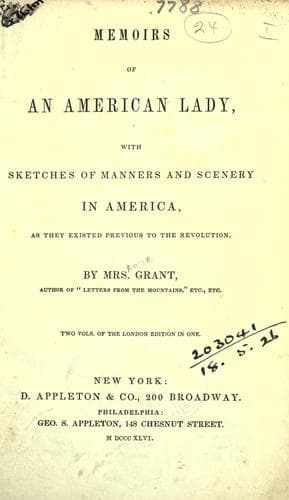
Memoirs of an American Lady: With Sketches of Manners and Scenery in America, as They Existed Previous to the RevolutionGrant, Anne MacVicar
History
Memoirs of an American Lady: With Sketches of Manners and Scenery in America, as They Existed Previous to the Revolution
Grant, Anne MacVicar
Indians of North America; New York (State) -- Social life and customs -- To 1775; Schuyler, Catalina, 1701-1778 or 1779
When a negro-woman’s child attained the age of three years, the first
New-Year’s day after, it was solemnly presented to a son or daughter, or
other young relative of the family, who was of the same sex with the
child so presented. The child to whom the young negro was given,
immediately presented it with some piece of money and a pair of shoes;
and from that day the strongest attachment subsisted between the
domestic and the destined owner. I have no where met with instances of
friendship more tender and generous, than that which here subsisted
between the slaves and their masters and mistresses. Extraordinary
proofs of them have been often given in the course of hunting or Indian
trading, when a young man and his slave have gone to the trackless woods
together, in the cases of fits of the ague, loss of a canoe, and other
casualties happening near hostile Indians. The slave has been known, at
the imminent risk of his life, to carry his disabled master through
trackless woods with labour and fidelity scarce credible; and the master
has been equally tender on similar occasions of the humble friend who
stuck closer than a brother; who was baptised with the same baptism,
nurtured under the same roof, and often rocked in the same cradle with
himself. These gifts of domestics to the younger members of the family
were not irrevocable; yet they were very rarely withdrawn. If the
kitchen family did not increase in proportion to that of the master,
young children were purchased from some family where they abounded, to
furnish those attached servants to the rising progeny. They were never
sold without consulting their mother, who, if expert and sagacious, had
a great deal to say in the family, and would not allow her child to go
into any family with whose domestics she was not acquainted. These
negro-women piqued themselves on teaching their children to be excellent
servants, well knowing servitude to be their lot for life, and that it
could only be sweetened by making themselves particularly useful, and
excelling in their department. If they did their work well, it is
astonishing, when I recollect it, what liberty of speech was allowed to
those active and prudent mothers. They would chide, reprove, and
expostulate in a manner that we would not endure from our hired
servants; and sometimes exert fully as much authority over the children
of the family as the parents, conscious that they were entirely in their
power. They did not crush freedom of speech and opinion in those by whom
they knew they were beloved, and who watched with incessant care over
their interest and comfort. Affectionate and faithful as these home-bred
servants were in general, there were some instances (but very few) of
those who, through levity of mind, or a love of liquor or finery,
betrayed their trust, or habitually neglected their duty. In these
cases, after every means had been used to reform them, no severe
punishments were inflicted at home. But the terrible sentence, which
Public-domain text, read in full here on John Shaqi.
Reviews
Reviews
No reviews yet
Be the first to share your thoughts on this work.
Join the Discussion
Join the discussion
Sign in to leave a comment or review.
Sign InorCreate an account