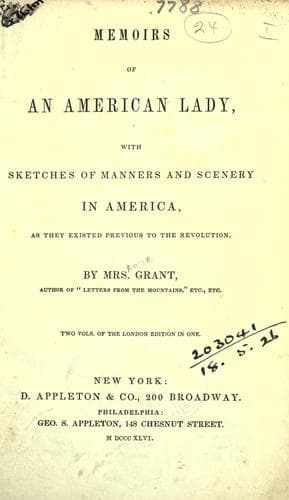
Memoirs of an American Lady: With Sketches of Manners and Scenery in America, as They Existed Previous to the RevolutionGrant, Anne MacVicar
History
Memoirs of an American Lady: With Sketches of Manners and Scenery in America, as They Existed Previous to the Revolution
Grant, Anne MacVicar
Indians of North America; New York (State) -- Social life and customs -- To 1775; Schuyler, Catalina, 1701-1778 or 1779
The melancholy Cowley, the ingenious bishop of Cloyne, and many others,
alike eminent for virtue and for genius, looked forward to this region
of liberty as a soil, where peace, science, and religion could have room
to take root and flourish unmolested. In those primeval solitudes,
enriched by the choicest bounties of nature, they might (as these
benevolent speculators thought) extend their shelter to tribes no longer
savage, rejoicing in the light of evangelic truth, and exalting science.
Little did these amiable projectors know how much is to be done before
the human mind, debased by habitual vice, and cramped by artificial
manners in the old world, can wash out its stains and resume its
simplicity in a new; nor did they know through how many gradual stages
of culture the untutored intellect of savage tribes must pass before
they become capable of comprehending those truths which to us habit has
rendered obvious, or which at any rate we have talked of so familiarly,
that we think we comprehend them. These projectors of felicity were not
so ignorant of human nature, as to expect change of place could produce
an instantaneous change of character; but they hoped to realize an
Utopia, where justice should be administered on the purest principles;
from which venality should be banished, and where mankind should,
through the paths of truth and uprightness, arrive at the highest
attainable happiness in a state not meant for perfection. They “talked
the style of gods,” making very little account of “chance and
sufferance.” Their speculations of the result remind me of what is
recorded in some ancient writer, of a project for building a magnificent
temple to Diana in some one of the Grecian states. A reward was offered
to him who should erect, at the public cost, with most taste and
ingenuity, a structure which should do honour both to the goddess and
her worshippers. Several candidates appeared. The first that spoke was a
self-satisfied young man, who, in a long florid harangue, described the
pillars, the porticoes, and the proportions of this intended building,
seeming all the while more intent on the display of his elocution, than
on the subject of his discourse. When he had finished, a plain elderly
man came from behind him, and leaning forwards, said in a deep hollow
voice, “All that he has said, I will do.”
William Penn was the man, born to give “a local habitation and a name,”
to all that had hitherto only floated in the day-dreams of poets and
philosophers.
Public-domain text, read in full here on John Shaqi.
Reviews
Reviews
No reviews yet
Be the first to share your thoughts on this work.
Elsewhere in the archive
Join the Discussion
Join the discussion
Sign in to leave a comment or review.
Sign InorCreate an account