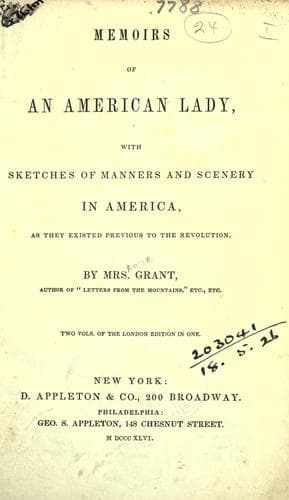
Memoirs of an American Lady: With Sketches of Manners and Scenery in America, as They Existed Previous to the RevolutionGrant, Anne MacVicar
History
Memoirs of an American Lady: With Sketches of Manners and Scenery in America, as They Existed Previous to the Revolution
Grant, Anne MacVicar
Indians of North America; New York (State) -- Social life and customs -- To 1775; Schuyler, Catalina, 1701-1778 or 1779
To qualify him for the legislator of a new-born sect, with all the
innocence and all the helplessness of infancy, many circumstances
concurred, that could scarce ever be supposed to happen at once to the
same person. Born to fortune and distinction, with a mind powerful and
cultivated, he knew, experimentally, all the advantages to be derived
from wealth or knowledge, and could not be said ignorantly to despise
them. He had, in his early days, walked far enough into the paths of
folly and dissipation, to know human character in all its varieties, and
to say experimentally, all is vanity. With a vigorous mind, an ardent
imagination, and a heart glowing with the warmest benevolence, he
appears to have been driven, by a repulsive abhorrence of the abuse of
knowledge, of pleasure, and pre-eminence, which he had witnessed, into
the opposite extreme; into a sect, the very first principles of which,
clip the wings of fancy, extinguish ambition, and bring every struggle
for superiority, the result of uncommon powers of mind, down to the dead
level of tame equality; a sect that reminds one of the exclusion of
poets from Plato’s fancied republic, by stripping off all the
many-coloured garbs with which learning and imagination have invested
the forms of ideal excellence, and reducing them to a few simple
realities, arrayed as soberly as their votaries.
This sect, which brings mankind to a resemblance of Thomson’s
Laplanders,
“Who little pleasure know, and feel no pain,”
might be supposed the last to captivate, nay, to absorb, such a mind as
I have been describing. Yet so it was: even in the midst of all this
cold humility, dominion was to be found. That rule, which of all others,
is most gratifying to a mind conscious of its own power, and directing
it to the purposes of benevolence, the voluntary subjection of mind, the
homage which a sect pays to its leader, is justly accounted the most
gratifying species of power; and to this lurking ambition, every thing
is rendered subservient by those who have once known this native and
inherent superiority. This man, who had wasted his inheritance,
alienated his relations, and estranged his friends; who had forsaken the
religion of his ancestors, and in a great measure, the customs of his
country; whom some charged with folly, and others with madness, was,
nevertheless, destined to plan with consummate wisdom, and execute with
indefatigable activity and immovable firmness, a scheme of government,
such as has been the wish, at least, of every enlarged and benevolent
mind, (from Plato downwards,) which has indulged speculations of the
kind. The glory of realizing, in some degree, all these fair visions,
was, however, reserved for William Penn alone.
Public-domain text, read in full here on John Shaqi.
Reviews
Reviews
No reviews yet
Be the first to share your thoughts on this work.
Elsewhere in the archive
Join the Discussion
Join the discussion
Sign in to leave a comment or review.
Sign InorCreate an account