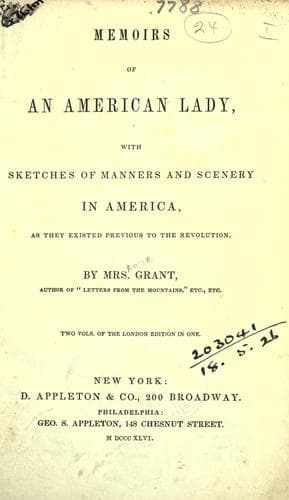
Memoirs of an American Lady: With Sketches of Manners and Scenery in America, as They Existed Previous to the Revolution — John Shaqi
Memoirs of an American Lady: With Sketches of Manners and Scenery in America, as They Existed Previous to the RevolutionGrant, Anne MacVicar
History
Memoirs of an American Lady: With Sketches of Manners and Scenery in America, as They Existed Previous to the Revolution
Grant, Anne MacVicar
Indians of North America; New York (State) -- Social life and customs -- To 1775; Schuyler, Catalina, 1701-1778 or 1779
Amidst all this mild and really tender indulgence to their negroes,
these colonists had not the smallest scruple of conscience with regard
to the right by which they held them in subjection. Had that been the
case, their singular humanity would have been incompatible with
continued injustice. But the truth is, that of law, the generality of
those people knew little; and of philosophy, nothing at all. They sought
their code of morality in the Bible, and there, imagined they found this
hapless race condemned to perpetual slavery; and thought nothing
remained for them but to lighten the chains of their fellow Christians,
after having made them such. This I neither “extenuate,” nor “set down
in malice,” but merely record the fact. At the same time, it is but
justice to record also a singular instance of moral delicacy,
distinguishing this settlement from every other in the like
circumstances, though, from their simple and kindly modes of life, they
were from infancy in habits of familiarity with these humble friends,
yet being early taught that nature had placed between them a barrier,
which was in a high degree criminal and disgraceful to pass, they
considered a mixture of such distinct races with abhorrence, as a
violation of her laws. This greatly conduced to the preservation of
family happiness and concord. An ambiguous race, which the law does not
acknowledge; and who (if they have any moral sense, must be as much
ashamed of their parents as these last are of them) are certainly a
dangerous, because degraded part of the community. How much more so must
be those unfortunate beings who stand in the predicament of the bat in
the fable, whom both birds and beasts disowned? I am sorry to say that
the progress of the British army, when it arrived, might be traced by a
spurious and ambiguous race of this kind. But of a mulatto born before
their arrival I only remember a single instance; and from the regret and
wonder it occasioned, considered it as singular. Colonel Schuyler, of
whom I am to speak, had a relation so weak and defective in capacity,
that he never was entrusted with any thing of his own, and lived an idle
bachelor about the family. In process of time a favourite negro-woman,
to the great offence and scandal of the family, bore a child to him,
whose colour gave testimony to the relation. The boy was carefully
educated; and when he grew up, a farm was allotted to him well stocked
and fertile, but “in depth of woods embraced,” about two miles back from
the family seat. A destitute white woman, who had somehow wandered from
the older colonies, was induced to marry him; and all the branches of
the family thought it incumbent on them now and then to pay a quiet
visit to Chalk (for so, for some unknown reason, they always called
him). I have been in Chalk’s house myself, and a most comfortable abode
it was; but considered him as a mysterious and anomalous being.
Public-domain text, read in full here on John Shaqi.
Reviews
Reviews
No reviews yet
Be the first to share your thoughts on this work.
Join the Discussion
Join the discussion
Sign in to leave a comment or review.
Sign InorCreate an account