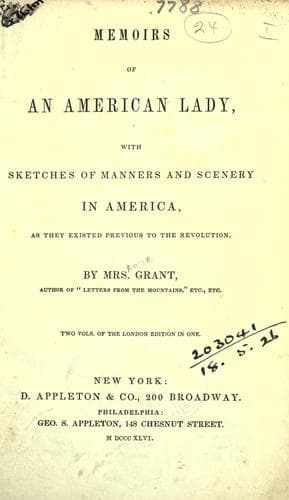
Memoirs of an American Lady: With Sketches of Manners and Scenery in America, as They Existed Previous to the RevolutionGrant, Anne MacVicar
History
Memoirs of an American Lady: With Sketches of Manners and Scenery in America, as They Existed Previous to the Revolution
Grant, Anne MacVicar
Indians of North America; New York (State) -- Social life and customs -- To 1775; Schuyler, Catalina, 1701-1778 or 1779
fall was attended with little danger, yet with much disgrace, for an
universal laugh from all sides, assailed the fallen charioteer. This
laugh was from a very full chorus, for the constant and rapid succession
of this procession, where every one had a brother, lover, or kinsman,
brought all the young people in town to the porticos, where they used to
sit, wrapt in furs, till ten or eleven at night, engrossed by this
delectable spectacle. What magical attraction it could possibly have, I
never could find out; but I have known an Albanian, after residing some
years in Britain, and becoming a polished, fine gentleman, join the
sport, and slide down with the rest. Perhaps, after all our laborious
refinements in amusement, being easily pleased is one of the great
secrets of happiness, as far as it is attainable in this “frail and
feverish being.”
Now there remains another amusement to be described, which I mention
with reluctance, and should scarce venture to mention at all, had I not
found a precedent for it among the virtuous Spartans. Had Lycurgus
himself, been the founder of their community, the young men could scarce
have stolen with more alacrity and dexterity. I could never conjecture
how the custom could possibly originate among a set of people of such
perfect and plain integrity; but thus it was. The young men now and then
spent a convivial evening at a tavern together, where, from the extreme
cheapness of liquor, their bills, (even when they committed an
occasional excess,) were very moderate. Either to lessen the expense of
the supper, or from the pure love of what they styled frolic, (anglicè
mischief,) they never failed to steal either a roasting pig, or a fat
turkey, for this festive occasion. The town was the scene of these
depredations, which never extended beyond it. Swine and turkeys were
reared in great numbers by all the inhabitants. For those they brought
to town in winter, they had an appropriate place at the lower end of the
garden, in which they were locked up. It is observable that these
animals were the only things locked up about the house, for this good
reason, that nothing else ran the least risk of being stolen. The
dexterity of the theft consisted in climbing over very high walls,
watching to steal in when the negroes went down to feed the horse or
cow, or making a clandestine entrance at some window or aperture;
breaking open doors was quite out of rule, and rarely ever resorted to.
These exploits were always performed in the darkest nights; if the owner
heard a noise in his stables, he usually ran down with a cudgel, and
laid it without mercy on any culprit he could overtake. This was either
dexterously avoided or patiently borne. To plunder a man, and afterwards
offer him any personal injury, was accounted scandalous; but the turkies
or pigs were never recovered. In some instances, a whole band of these
young plunderers would traverse the town, and carry off such a prey as
Public-domain text, read in full here on John Shaqi.
Reviews
Reviews
No reviews yet
Be the first to share your thoughts on this work.
Join the Discussion
Join the discussion
Sign in to leave a comment or review.
Sign InorCreate an account