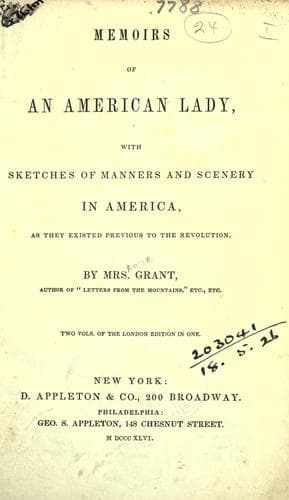
Memoirs of an American Lady: With Sketches of Manners and Scenery in America, as They Existed Previous to the RevolutionGrant, Anne MacVicar
History
Memoirs of an American Lady: With Sketches of Manners and Scenery in America, as They Existed Previous to the Revolution
Grant, Anne MacVicar
Indians of North America; New York (State) -- Social life and customs -- To 1775; Schuyler, Catalina, 1701-1778 or 1779
shelter of the orchard fence, on the shadiest side; and never were
neighbours more harmless, peaceable, and obliging—I might truly add
industrious, for in one way or other they were constantly occupied. The
women and their children employed themselves in many ingenious
handicrafts, which, since the introduction of European arts and
manufactures, have greatly declined. Baking trays, wooden dishes, ladles
and spoons, shovels and rakes, brooms of a peculiar manufacture, made by
splitting a birch block into slender but tough filaments; baskets of all
kinds and sizes, made of similar filaments, enriched with the most
beautiful colours, which they alone knew how to extract from vegetable
substances, and incorporate with the wood. They made also of the
birch-bark, (which is here so strong and tenacious, that cradles and
canoes are made of it,) many receptacles for holding fruit and other
things, curiously adorned with embroidery—not inelegant, done with the
sinews of deer, and leggins and moomesans, a very comfortable and highly
ornamental substitute for shoes and stockings, then universally used in
winter among the men of our own people. They had also a beautiful
manufacture of deer skin, softened to the consistence of the finest
Chamois leather, and embroidered with beads of wampum, formed like
bugles; these, with great art and industry, they formed out of shells,
which had the appearance of fine, white porcelain, veined with purple.
This embroidery showed both skill and taste, and was among themselves
highly valued. They had belts, large embroidered garters, and many other
ornaments, formed, first of deer sinews, divided to the size of coarse
thread, and afterwards, when they obtained worsted thread from us, of
that material, formed in a manner which I could never comprehend. It was
neither knitted nor wrought in the manner of net, nor yet woven—but the
texture was formed more like an officer’s sash than any thing I can
compare it to. While the women and children were thus employed, the men
sometimes assisted them in the more laborious part of their business,
but oftener occupied themselves in fishing on the rivers, and drying or
preserving, by means of smoke, in sheds erected for the purpose,
sturgeon and large eels, which they caught in great quantities, and of
an extraordinary size, for winter provision.
Boys on the verge of manhood, and ambitious to be admitted into the
hunting parties of the ensuing winter, exercised themselves in trying to
improve their skill in archery, by shooting birds, squirrels, and
raccoons. These petty huntings helped to support the little colony in
the neighbourhood, which, however, derived its principal subsistence
from an exchange of their manufactures with the neighbouring family, for
milk, bread, and other articles of food.
Public-domain text, read in full here on John Shaqi.
Reviews
Reviews
No reviews yet
Be the first to share your thoughts on this work.
Join the Discussion
Join the discussion
Sign in to leave a comment or review.
Sign InorCreate an account