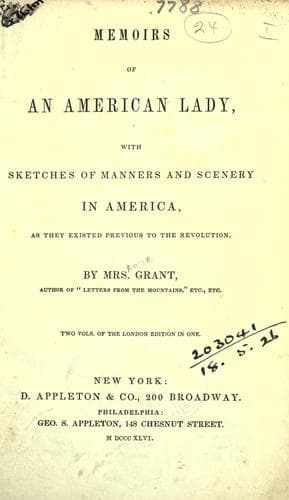
Memoirs of an American Lady: With Sketches of Manners and Scenery in America, as They Existed Previous to the RevolutionGrant, Anne MacVicar
History
Memoirs of an American Lady: With Sketches of Manners and Scenery in America, as They Existed Previous to the Revolution
Grant, Anne MacVicar
Indians of North America; New York (State) -- Social life and customs -- To 1775; Schuyler, Catalina, 1701-1778 or 1779
to pass their summers near the settlers, were of detached and wandering
families, who preferred this mode of living to the labour of tilling the
ground, which entirely devolved upon the women among the Five Nations.
By tilling the ground, I would not be understood to mean any settled
mode of agriculture, requiring cattle, inclosures, or implements of
husbandry. Grain made but a very subordinate part of their subsistence,
which was chiefly derived from fishing and hunting. The little they had
was maize; this, with kidney-beans and tobacco, the only plants they
cultivated, was sown in some very pleasant fields along the Mohawk
river, by the women, who had no implements of tillage but the hoe, and a
kind of wooden spade. These fields laid round their _castles_—and while
the women were thus employed, the men were catching and drying fish by
the rivers or on the lakes. The younger girls, were much busied during
summer and autumn, in gathering wild fruits, berries, and grapes, which
they had a peculiar mode of drying, to preserve them for the winter. The
great cranberry they gathered in abundance, which, without being dried,
would last the whole winter, and was much used by the settlers. These
dried fruits were no luxury; a fastidious taste would entirely reject
them. Yet, besides furnishing another article of food, they had their
use, as was evident. Without some antiseptic, they who lived the whole
winter on animal food, without a single vegetable, or any thing of the
nature of bread, unless now and then a little maize, which they had the
art of boiling down to softness in lye of wood-ashes, must have been
liable to that great scourge of northern nations, in their primitive
state, the _scurvy_, had not this simple desert been a preservative
against it. Rheumatisms, and sometimes agues affected them, but no
symptom of any cutaneous disease was ever seen on an Indian.
The stragglers, from the confines of the orchards, did not fail to join
their tribes in winter, and were zealous, and often successful in
spreading their new opinions. Indians supposed that every country had
its own mode of honouring the Great Spirit, to whom all were equally
acceptable. This had, on one hand, the bad effect of making them
satisfied with their own vague and undefined notions; and on the other,
the good one of making them very tolerant of those of others. If you do
not insult their belief, (for mode of worship they have scarce any,)
they will hear you talk of yours with the greatest patience and
attention; their good breeding, in this respect, was really superlative.
No Indian ever interrupted any the most idle talker; but when he
concluded, he would deliberately, methodically, and not ungracefully
answer or comment upon all he had said, in a manner which showed that
not a word had escaped him.
Public-domain text, read in full here on John Shaqi.
Reviews
Reviews
No reviews yet
Be the first to share your thoughts on this work.
Join the Discussion
Join the discussion
Sign in to leave a comment or review.
Sign InorCreate an account