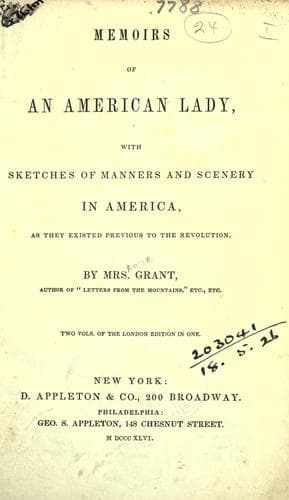
Memoirs of an American Lady: With Sketches of Manners and Scenery in America, as They Existed Previous to the RevolutionGrant, Anne MacVicar
History
Memoirs of an American Lady: With Sketches of Manners and Scenery in America, as They Existed Previous to the Revolution
Grant, Anne MacVicar
Indians of North America; New York (State) -- Social life and customs -- To 1775; Schuyler, Catalina, 1701-1778 or 1779
This digression, long as it is, has a very intimate connexion with the
character of my friend, who early adopted the views of her family, in
regard to those friendly Indians, which greatly enlarged her mind, and
ever after influenced her conduct. She was, even in childhood, well
acquainted with their language, opinions, and customs; and, like every
other person possessed of a liberality or benevolence of mind, whom
chance had brought acquainted with them, was exceedingly partial to
those high-souled and generous natives. The Mohawk language was early
familiar to her; she spoke Dutch and English with equal ease and purity,
was no stranger to the French tongue, and could, (I think,) read German:
I have heard her speak it. From the conversations which her active
curiosity led her to hold with native Africans, brought into her
father’s family, she was more intimately acquainted with the customs,
manners, and government of their native country, than she could have
been, by reading all that was ever written on the subject. Books are, no
doubt, the granaries of knowledge; but a diligent, inquiring mind, in
the active morning of life, will find it strewed like manna, over the
face of the earth—and need not, in all cases, rest satisfied with
intelligence accumulated by others, and tinctured with their passions
and prejudices. Whoever reads Homer or Shakspeare, may daily discover
that they describe both nature and art from their own observation.
Consequently, you see the images reflected from the mirror of their
great minds, differing from the descriptions of others, as the
reflection of an object in all its colours and proportions, from an
unpolished surface, does from a shadow on a wall, or from a picture
drawn from recollection. The enlarged mind of my friend, and her simple,
yet easy and dignified manners, made her readily adapt herself to those
with whom she conversed, and every where command respect and
kindness—and, on a nearer acquaintance, affection followed; but she had
too much sedateness and independence to adopt those caressing and
insinuating manners, by which the vain and the artful so soon find their
way into shallow minds. Her character did not captivate at once, but
gradually unfolded itself, and you had always something new to discover.
Her style was grave and masculine, without the least embellishment—and
at the same time so pure, that every thing she said might be printed
without correction, and so plain, that the most ignorant and most
inferior persons were never at a loss to comprehend it. It possessed,
too, a wonderful flexibility; it seemed to rise and fall with the
subject. I have not met with a style, which, to noble and uniform
simplicity, united such variety of expression. Whoever drinks knowledge
pure at its sources, solely from a delight in filling the capacities of
a large mind, without the desire of dazzling or out-shining others;
whoever speaks for the sole purpose of conveying to other minds those
Public-domain text, read in full here on John Shaqi.
Reviews
Reviews
No reviews yet
Be the first to share your thoughts on this work.
Join the Discussion
Join the discussion
Sign in to leave a comment or review.
Sign InorCreate an account