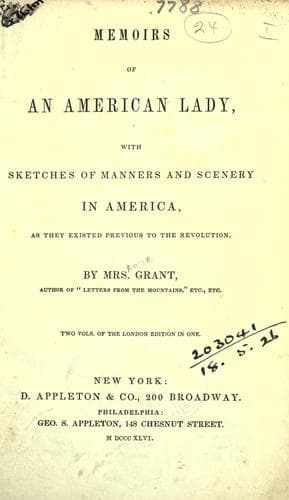
Memoirs of an American Lady: With Sketches of Manners and Scenery in America, as They Existed Previous to the RevolutionGrant, Anne MacVicar
History
Memoirs of an American Lady: With Sketches of Manners and Scenery in America, as They Existed Previous to the Revolution
Grant, Anne MacVicar
Indians of North America; New York (State) -- Social life and customs -- To 1775; Schuyler, Catalina, 1701-1778 or 1779
According to the laudable custom of the country, they took home a child,
whose mother had died in giving her birth, and whose father was a
relation of the colonel’s. This child’s name was either Schuyler or
Cuyler, I do not exactly remember which; but I remember her many years
after, as Mrs. Vander Poolen—when, as a comely, contented-looking
matron, she used to pay her annual visit to her beloved benefactress and
send her ample presents of such rural dainties as her abode afforded. I
have often heard her warm in her praises; saying, how useful, how
modest, and how affectionate she had been—and exulting in her
comfortable settlement, and the plain worth, which made her a blessing
to her family. From this time to her aunt’s death, above fifty years
afterwards, her house was never without one, but much oftener two
children, whom this exemplary pair educated with parental care and
kindness. And whenever one of their protégéss married out of the house,
which was generally at a very early age, she carried with her a female
slave, born and baptised in the house, and brought up with a thorough
knowledge of her duty, and an habitual attachment to her mistress,
besides the usual present of the furniture of a chamber, and a piece of
plate, such as a teapot, tankard, or some such useful matter, which was
more or less valuable, as the protégés was more or less beloved; for
though aunt Schuyler had great satisfaction from the characters and
conduct of all her adopted, there were, no doubt, degrees of merit among
them, of which she was better able to judge than if she had been their
actual mother.
There was now an interval of peace, which gave these philanthropists
more leisure to do good in their own way. They held a threefold band of
kindness in their hands, by which they led to the desirable purpose of
mutual advantage three very discordant elements, which were daily
becoming more difficult to mingle and to rule; and which yet were the
more dependent on each other for mutual comfort, from the very causes
which tended to disunite them.
Public-domain text, read in full here on John Shaqi.
Reviews
Reviews
No reviews yet
Be the first to share your thoughts on this work.
Elsewhere in the archive
Join the Discussion
Join the discussion
Sign in to leave a comment or review.
Sign InorCreate an account