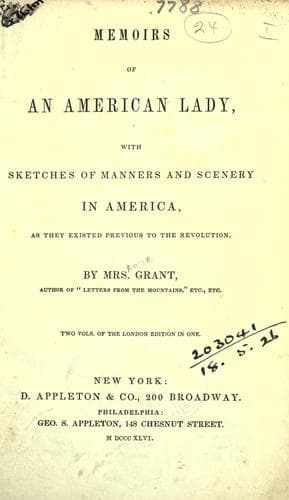
Memoirs of an American Lady: With Sketches of Manners and Scenery in America, as They Existed Previous to the RevolutionGrant, Anne MacVicar
History
Memoirs of an American Lady: With Sketches of Manners and Scenery in America, as They Existed Previous to the Revolution
Grant, Anne MacVicar
Indians of North America; New York (State) -- Social life and customs -- To 1775; Schuyler, Catalina, 1701-1778 or 1779
In the first place, the Indians began to assume that unfavourable and
uncertain aspect, which it is the fate of man to wear in the first steps
of his progress from that state where he is a being at once warlike and
social, having few wants, and being able, without constant labour or
division of ranks, to supply them; where there is no distinction, save
that attained by superior strength of mind and body, and where there are
no laws, but those dictated by good sense, aided by experience, and
enforced by affection, this state of life may be truly called the reign
of the affections: the love of kindred and of country, ruling paramount,
unrivalled by other passions, all others being made subservient to
these. Vanity, indeed, was in some degree flattered, for people wore
ornaments, and were at no small pains to make them. Pride existed—but
was differently modified from what we see it; every man was proud of the
prowess and achievements of his tribe collectively; of his personal
virtues he was not proud, because we excel but by comparison; and he
rarely saw instances of the opposite vices in his own nation, and looked
on others with unqualified contempt.
When any public benefit was to be obtained, or any public danger to be
averted, their mutual efforts were all bent to one end; and no one knew
what it was to withhold his utmost aid, nor indeed could, in that stage
of society, have any motive for doing so. Hence, no mind being
contracted by selfish cares, the community were but as one large family,
who enjoyed or suffered together. We are accustomed to talk, in parrot
phrase, of indolent savages; and, to be sure, in warm climates, and
where the state of man is truly savage, that is to say, unsocial, void
of virtue, and void of comforts, he is certainly an indolent being: but
that individual, in a cold climate, who has tasted the sweets of social
life—who knows the wants that arise from it—who provides for his
children in their helpless state—and where taste and ingenuity are so
much improved, that his person is not only clothed with warm and seemly
apparel, but decorated with numerous and not inelegant ornaments, which
from the scarcity and simplicity of his tools, he has no ready or easy
mode of producing. When he has not only found out all these wants, which
he has no means of supplying but by his individual strength, dexterity,
and ingenuity, industry must be added, ere they can be all regularly
gratified. Very active and industrious, in fact, the Indians were in
their original state; and when we take it into consideration, that
beside all these occupations, together with their long journeys, wars,
and constant huntings and fishing, their leisure was occupied not only
by athletic but studious games, at which they played for days together
with unheard-of eagerness and perseverance; it will appear they had very
little of that lounging time, for which we are so apt to give them
credit. Or if a chief, occasionally after fatigue, of which we can form
Public-domain text, read in full here on John Shaqi.
Reviews
Reviews
No reviews yet
Be the first to share your thoughts on this work.
Elsewhere in the archive
Join the Discussion
Join the discussion
Sign in to leave a comment or review.
Sign InorCreate an account