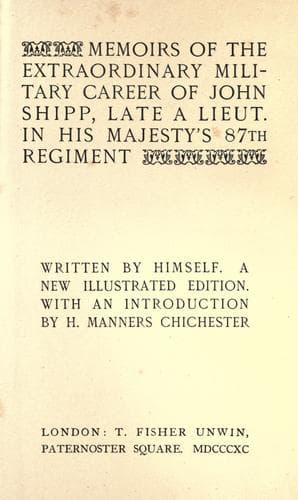
Memoirs of the Extraordinary Military Career of John Shipp: Late a Lieut. in His Majesty's 87th RegimentShipp, John
History
Memoirs of the Extraordinary Military Career of John Shipp: Late a Lieut. in His Majesty's 87th Regiment
Shipp, John
India -- History -- British occupation, 1765-1947 -- Biography; Shipp, John, 1784-1834
Our next object was to commit the poor fellows who were killed to the
grave; for which purpose an enormous working-party was employed to bury
the dead, and take the wounded to our hospitals. In two days, eleven
hundred were committed to the grave, having almost one general tomb; and
it would have much edified those babblers who rail so much against
soldiers' cruelties and vices, to have seen the tear of compassion
trickling down the cheeks of both natives and Europeans on this
occasion. Having performed our sad duty, we were relieved at mid-day,
and returned to the lines, amidst the greetings of our comrades at the
foot of the hill. The orders of the day were flattering and
complimentary to all engaged. These were little trophies gained that no
man could rob or cheat us of. Having washed and dressed myself, I went
to the hospital to visit both my friends and those that had been, a
short day before, my mortal enemies. It had been a considerable time
before our wounded men could be removed from the hill, and then the
bringing them down so shook them, that, in many cases, inflammation had
taken place. Some of these poor suffering fellows seemed to endure the
most excruciating pangs. Every comfort that liberality could purchase
was afforded to the sufferers, and it gladdened my heart when I went
into the tents of the wounded of the enemy, to see some of our native
soldiers on their knees, waiting on and administering comforts to them,
while others were whispering sweet words of consolation into their
attentive ears, which were the more necessary, as some of these poor
creatures had an idea that their lives were only prolonged for a more
cruel and lingering death. An amputation had been thought necessary on
the leg of one of the native enemy. This he submitted to almost without
a struggle. When his leg was off, and the stump dressed, it confirmed
him in what he had been taught from his infancy, that almost all white
men were cannibals; and he asked one of his friends who was lying by
him (one of his countrymen), "when he thought they would take the other
leg off; as, if he thought it would be long, he would destroy himself."
This being understood by one of the hospital attendants, to ease his
mind, it was thought proper to explain to him that the act was one of
kindness, not of cruelty, and done to save his life. For this purpose
one of his countrymen, a spy of ours, was sent for; nothing, however,
but the sight of the same operation performed on one of our native men,
could appease and satisfy him. After having witnessed this, he became
calm, and felt satisfied that we were not such barbarians as he had been
taught to suppose. Our humane general had directed that men of the same
caste should attend the wounded prisoners of war, and volunteers in
abundance came forward for this benevolent purpose. It was a truly
pleasurable and delightful sight to witness those who, but a short day
Public-domain text, read in full here on John Shaqi.
Reviews
Reviews
No reviews yet
Be the first to share your thoughts on this work.
Elsewhere in the archive
Join the Discussion
Join the discussion
Sign in to leave a comment or review.
Sign InorCreate an account